Justice Madhav Jamdar highlights extensive work hours, citing them as cause for judgment delay in specific performance case.
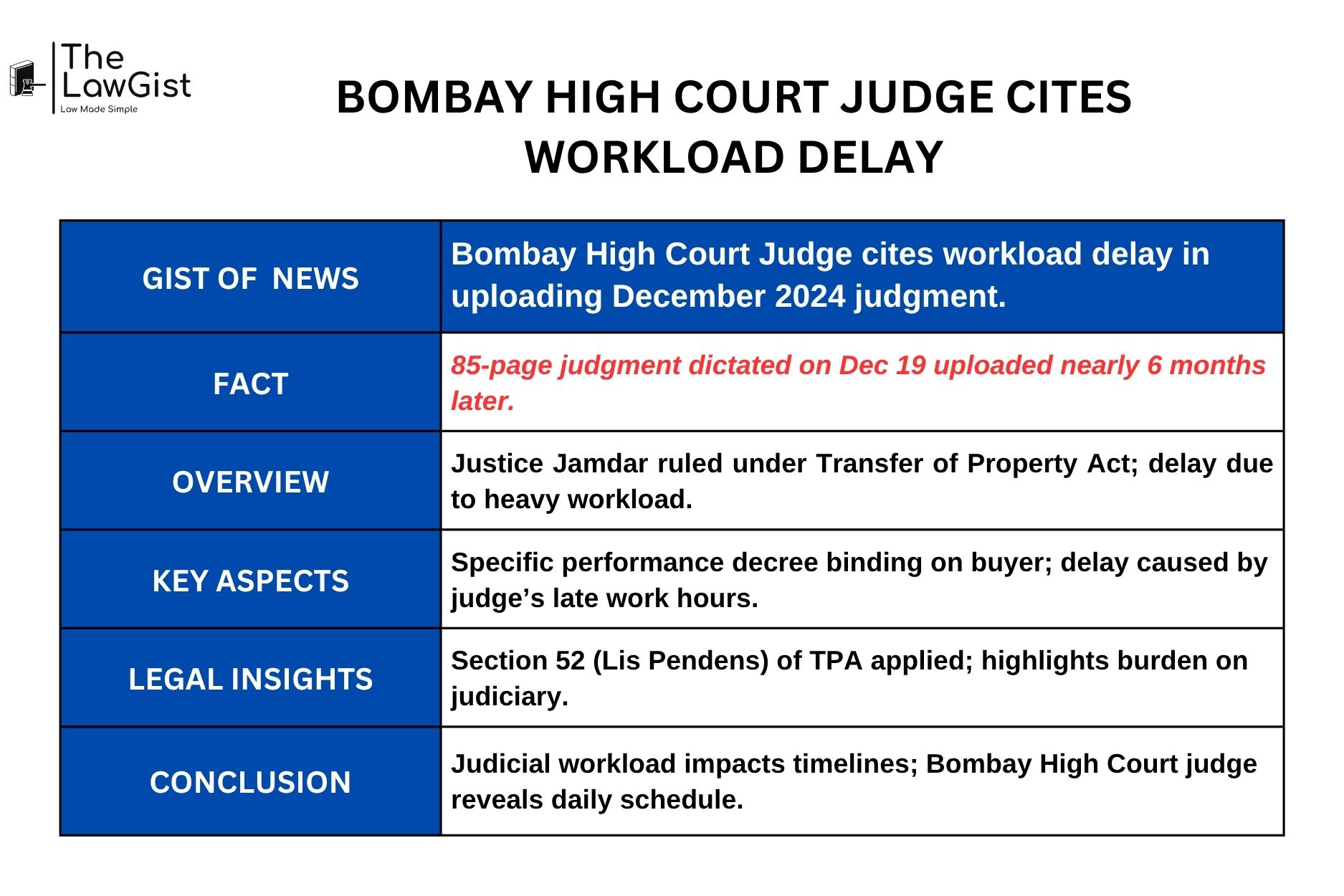
Gist of NewsBombay High Court Judge cites workload delay in uploading a judgment dictated in December 2024. An 85-page judgment dictated on December 19, 2024 was uploaded only on May 30, 2025 . |
The matter highlights the tremendous pressure on the judiciary, especially on individual judges managing multiple cases daily . Justice Madhav Jamdar of the Bombay High Court issued a judgment in open court that was significantly delayed in publication due to his workload .
Key Aspects
This case revolves around the applicability of specific performance and its impact on third-party purchasers . The judge’s observations also reflect the hidden workload burden on the judiciary.
- The case was related to the Transfer of Property Act focusing on specific performance .
- The judgment held that a purchaser is bound by a decree passed during the pendency of a suit .
- It was dictated on December 19, 2024 but uploaded on the court website only on May 30, 2025 .
- Justice Jamdar mentioned working until 2:00 AM daily including weekends and holidays .
Legal Insights
The ruling highlights important legal doctrines while also underlining structural issues in the justice system.
- Section 52 of the Transfer of Property Act (Doctrine of Lis Pendens) applied in this case .
- The ruling emphasized that third-party buyers must respect ongoing litigation .
- It reflects the strain due to workload of judges, impacting efficiency and delivery timelines .
Conclusion
This incident not only highlights the judicial principle under the Transfer of Property Act but also exposes the intense workload of judges in the Bombay High Court . There is a need for systemic support to reduce delays while safeguarding judicial integrity .
Source- High Court of Bombay
Read also – Difference between decree abd order