
Bharatiya Sakshya Adhiniyam (Evidence Law)
The Indian Evidence Law has been superseded by the Bharatiya Sakshya Adhiniyam, marking a significant evolution in the regulation of evidence presentation in Indian courts. Enacted on December 25, 2023, the Bharatiya Sakshya Adhiniyam meticulously governs the admissibility, examination, and cross-examination of evidence, ensuring fairness and impartiality in legal proceedings. This replacement aims to uphold the integrity of the justice system by admitting only relevant and reliable evidence for consideration during trials. Like its predecessor, the Indian Evidence Act of 1872, the new law divides evidence into various types and establishes rules for its presentation. With its comprehensive provisions, including those concerning relevancy, presumption, burden of proof, and admissibility, the Bharatiya Sakshya Adhiniyam stands as a cornerstone of fair and equitable adjudication. Enforced from July 1, 2024, it reflects India’s commitment to modernizing legal frameworks to meet the evolving needs of its justice system while ensuring the protection of citizens’ rights.
Recent Posts
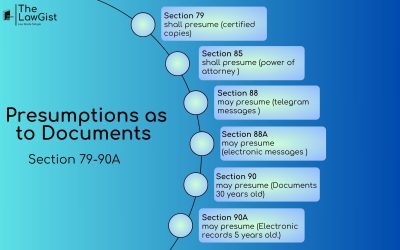
PRESUMPTIONS AS TO DOCUMENTS (SECTION 79 – 90A)
SECTION 79 (shall presume)- If a Certified Copy of a document is presented in court as evidence, it's assumed genuine. The copy must match legal form and execution. If someone disputes its authenticity, they must prove their claim. SECTION 85 (shall presume)- This law...
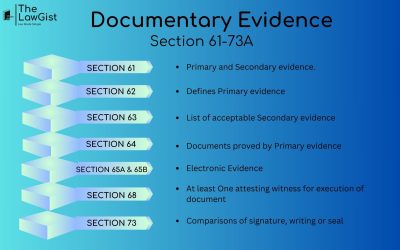
DOCUMENTARY EVIDENCE (SECTION 61-73A)
SECTION 61- Outlines that document contents can be proven through- Primary Evidence or Secondary Evidence. Section 64 establishes the best evidence rule, requiring Primary Evidence for document proof, except when Section 65 exceptions apply. In essence, documents are...
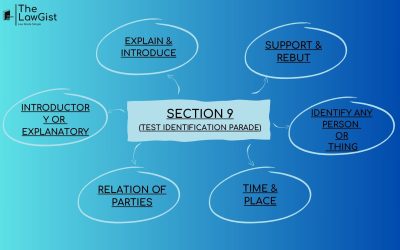
TEST IDENTIFICATION PARADE (SECTION 9)
FACTS NECESSARY TO EXPLAIN OR INTRODUCE RELEVANT FACTS (SECTION 9 ) Facts which are necessary to explain or introduce fact in issue or relevant fact, Facts which support or rebut an inference which are so connected with fact in issue or relevant fact, Which helps to...
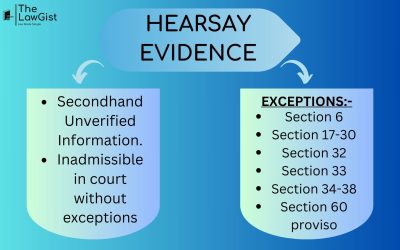
HEARSAY EVIDENCE
The Indian Evidence Act doesn't provide a specific definition for ‘ Hearsay Evidence’. Stephen explains that the term ‘ Hearsay' is used in different contexts, at times referring to something a person directly says, and at other times indicating a statement made based...
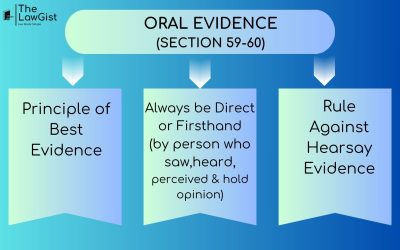
ORAL EVIDENCE (SECTION 59 -60)
Oral Evidence refers to statements allowed or mandated by the court, made by witnesses regarding factual matters under investigation. This concept is outlined in Section 119, which allows witnesses who cannot speak to provide comprehensible evidence through writing...
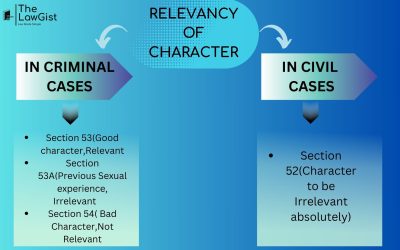
RELEVANCY OF CHARACTER (SECTION 52-55)
Relevancy of Character in Criminal Cases:- Section 53 ( Good Character,Relevant) - In criminal proceedings, the character of the accused plays a relevant role in assessing their innocence or guilt. The accused has the right to present evidence of their good character,...