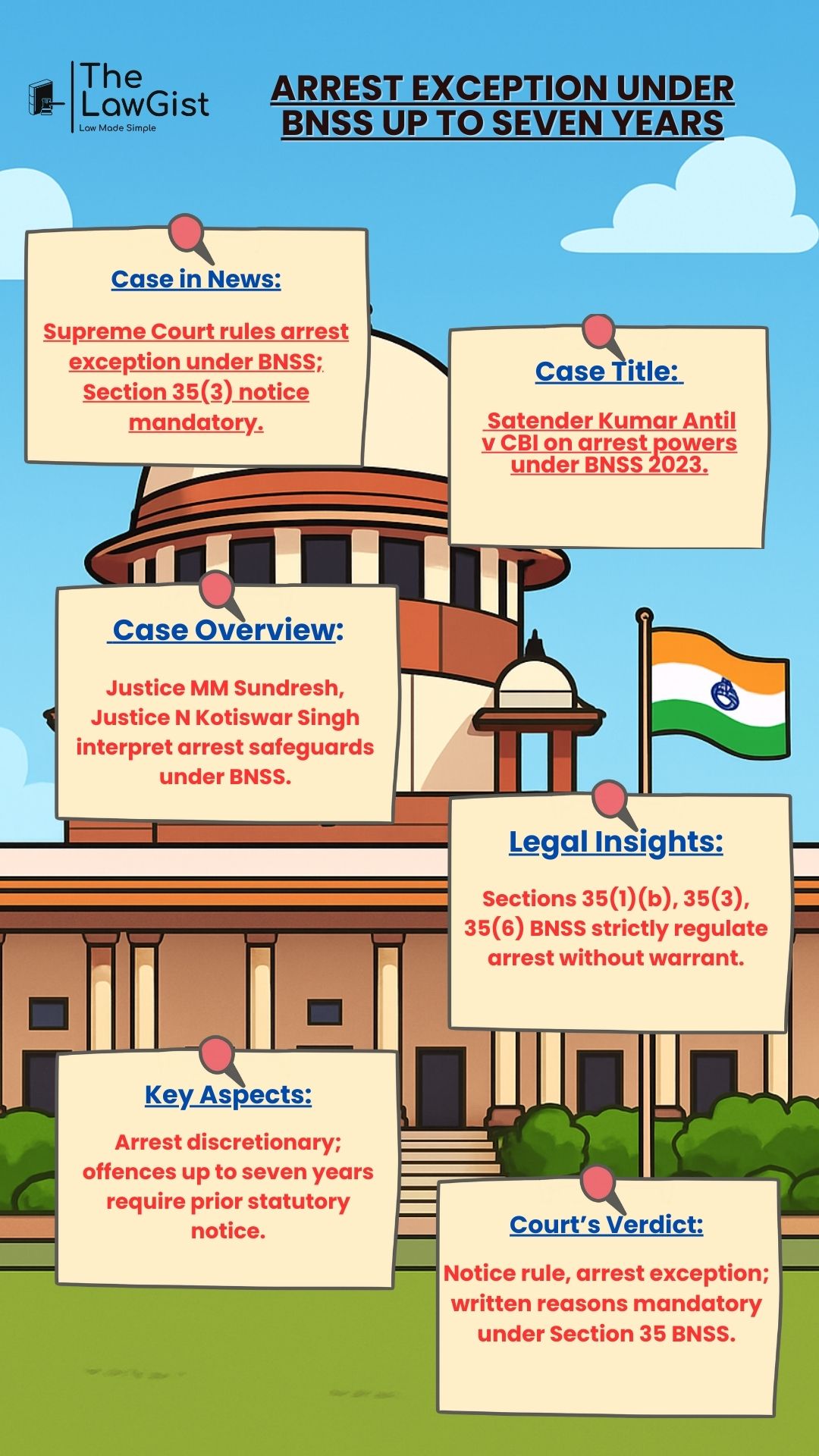
Case in NewsArrest Exception Under BNSS Up To Seven Years reaffirmed as notice mandatory by Supreme Court ruling . |
Discover powerful Latin Maxims and simplify complex legal terms in seconds.
Case Overview
Case Name: Satender Kumar Antil vs. Central Bureau of Investigation
In Satender Kumar Antil v. CBI the Supreme Court of India comprising Justice MM Sundresh & Justice N Kotiswar Singh examined the scope of police powers of arrest under the Bharatiya Nagarik Suraksha Sanhita, 2023. The Court addressed whether issuance of notice under Section 35(3) of BNSS is mandatory for offences punishable with imprisonment up to 7 years reinforcing the primacy of personal liberty in criminal investigations.
Step into the world of justice with Courtroom Chronicles
Key Aspects
Before delving into the facts & issues the Court underscored that arrest is not a punitive measure but a procedural tool to aid investigation . The judgment stressed that unnecessary arrests violate personal liberty & statutory safeguards under BNSS.
- The issue arose regarding routine arrests in offences punishable up to 7 years .
- The petitioner challenged arrest without prior statutory notice .
- The Court examined the discretionary nature of arrest powers.
- The balance between investigation needs & individual liberty was central.
Legal Insights
The Court undertook a detailed interpretation of arrest-related provisions under BNSS . It clarified that statutory conditions must coexist before depriving a person of liberty & even then, arrest is not automatic.
- Section 35 BNSS: Governs arrest without warrant & limits police discretion.
- Section 35(1)(b)(i) BNSS: Needs reasonable belief of offence commission .
- Section 35(1)(b)(ii) BNSS: Mandates necessity of arrest for specified purposes like investigation or preventing tampering.
- Section 35(3) of BNSS: Makes issuance of notice of appearance mandatory for offences punishable up to 7 years.
- Section 35(6) BNSS: Permits arrest after notice only as an exception not routine.
Court’s Verdict
The Supreme Court of India held that for offences punishable up to 7 years, issuance of notice under Section 35(3) of BNSS is the rule while arrest is an exception. Even when statutory conditions exist, arrest must be absolutely necessary & supported by written reasons. Compliance with notice bars arrest reaffirming liberty-focused policing under BNSS.
Source – Supreme Court of India
Read also – BNSS
The LawGist ensures exam success with quality notes—TPL, Current Affairs, Recent Judgments, and more. Backed by trusted resources and videos, The LawGist is every aspirant’s first choice.