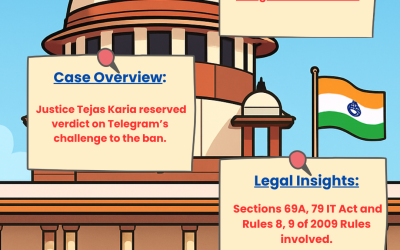
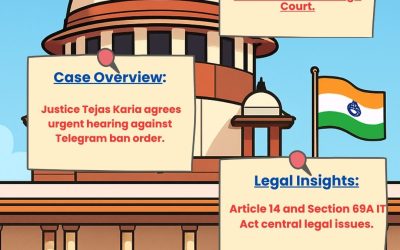
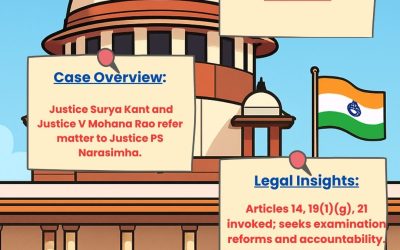
Supreme Court of India discussing Aadhaar age checks and stronger regulations to control harmful online content while balancing free speech and protecting the dignity of persons with disabilities.
Case in NewsSupreme Court of India considers Aadhaar-based age checks for regulation of Online content amid controversy . |
Discover powerful Latin Maxims and simplify complex legal terms in seconds.
Case Overview
Case Name: Ranveer Allahbadia & Ors. v. Union of India & Ors.
The Supreme Court of India, led by CJI Surya Kant and Justice Joymalya Bagchi, heard petitions concerning allegations against Ranveer Allahbadia and Samay Raina relating to obscene remarks and insulting content targeting persons with disabilities . The matter raised constitutional concerns about balancing free speech with the right to dignity and the need for a structured framework to govern digital platforms . The Court also examined whether age verification and stricter legal measures were essential for safeguarding vulnerable sections .
Step into the world of justice with Courtroom Chronicles
Key Aspects
Before beginning the issues, the Court stressed that uncontrolled digital content spreads rapidly, leaving victims helpless by the time legal remedies are sought . It reiterated that existing self-regulatory bodies have failed to prevent repeated misuse of online platforms . Therefore, a structured, independent regulatory framework is required to manage harmful digital material .
- Obscene and pre-scripted content uploaded by comedians, affecting public morality .
- Humiliating remarks against persons with disabilities, impacting dignity and access to crowdfunding .
- Concerns about vague “anti-national” content and lack of timely government response .
- Absence of an autonomous authority for regulation of Online content .
- Tension between free speech (Article 19) and the right to dignity (Article 21) .
Legal Insights
Before examining the provisions, the Court highlighted that constitutional freedoms are not absolute and online platforms require stricter checks to prevent harm, especially to vulnerable communities . The Court also emphasised the need for legal reforms where current laws appear insufficient .
- Article 19(1)(a) – Freedom of Speech: Protects expression but does not permit harmful or obscene digital behaviour .
- Article 19(2) of Constitution of India -Reasonable Restrictions: Allows restrictions in interests of decency, morality, public order and integrity—relevant to obscene and disruptive online content .
- Article 21 – Right to Life and Dignity: Protects dignity of persons with disabilities; degrading content violates this right .
- SC/ST (Prevention of Atrocities) Act, 1989 (Suggested Parallel Framework): Court suggested a similar stringent statutory model to penalise insults or derogatory remarks against persons with disabilities .
- Information Technology Act, 2000 & IT Rules, 2021: Provide the statutory basis for regulating intermediaries and harmful online content; Court hinted amendments may be needed .
- Aadhaar-Based Age Verification (Suggested Mechanism): Proposed as a lawful method to filter explicit or adult digital content .
Court’s Verdict
The Supreme Court of India directed the Centre to hold consultations and present a structured proposal for the regulation of Online content . It recommended forming an autonomous regulatory authority, strengthening protection laws for persons with disabilities, and exploring Aadhaar-based age verification . The Court encouraged Ranveer Allahbadia and Samay Raina to conduct monthly fundraising events supporting disabled children . The matter will be heard again after four weeks .
Source – Supreme Court of India
Read also – Constitution of India
The LawGist ensures exam success with quality notes—TPL, Current Affairs, Recent Judgments, and more. Backed by trusted resources and videos, The LawGist is every aspirant’s first choice.