SUPREME COURT HOLDS MISSING RAILWAY TICKET CANNOT DEFEAT RAILWAY ACCIDENT COMPENSATION CLAIM
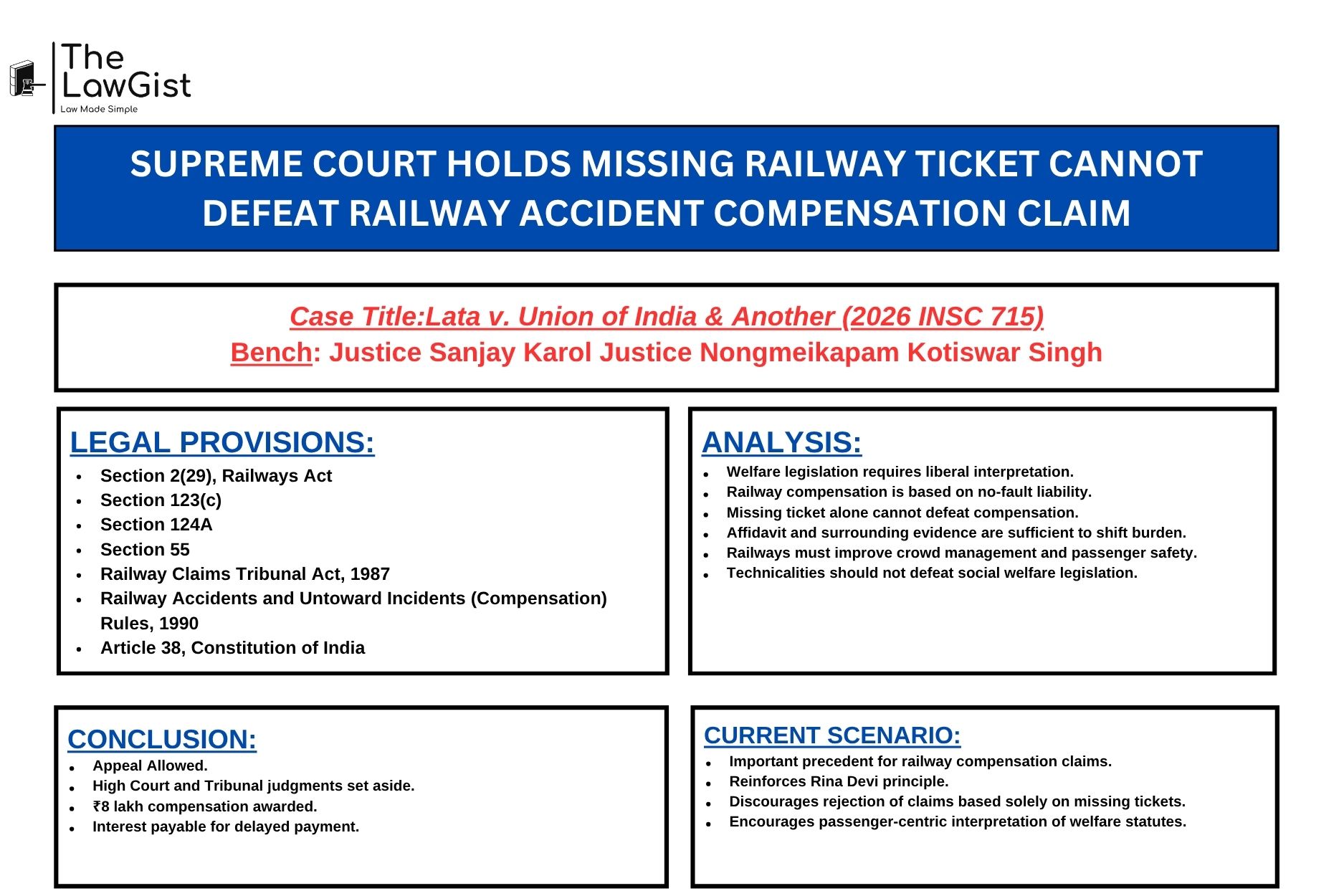
CASE SUMMARY – The Supreme Court in Lata vs. Union of India (2026) held that compensation under Section 124A of the Railways Act cannot be denied merely because the deceased passenger’s railway ticket was not recovered after an accidental fall from a moving train. The Court reaffirmed that railway accident compensation is based on a no-fault liability principle and that beneficial legislation must receive a liberal and purposive interpretation. An affidavit and surrounding circumstances are sufficient to establish prima facie bona fide passenger status, shifting the burden to the Railways. The Court awarded ₹8 lakh compensation and emphasized improved passenger safety, crowd management, and humanitarian justice.
| Particulars | Details |
| Case Title | Lata vs. Union of India & Another (2026 INSC 715) |
| Introduction | The Supreme Court considered whether compensation under Section 124A of the Railways Act, 1989 can be denied merely because the deceased passenger’s railway ticket was not recovered after an accidental fall from a moving train. The Court emphasized the welfare nature of railway compensation laws and adopted a liberal interpretation favouring victims. |
| Factual Background | Chandrakant Thakkar was travelling from Raipur to Ahmedabad when he accidentally fell from Train No.12834 on 28 November 2015 and died. His wife, Lata, claimed compensation before the Railway Claims Tribunal stating that the ticket was lost along with the deceased’s travel bag. The Tribunal and High Court rejected the claim holding that the deceased was not proved to be a bona fide passenger because the ticket was not recovered. |
| Legal Issues | 1. Whether non-recovery of the railway ticket defeats a compensation claim under Section 124A.
2. Whether an affidavit and surrounding circumstances can establish bona fide passenger status. 3. Whether the Railways Act is a beneficial legislation requiring liberal interpretation. |
| Applicable Law | • Sections 2(29), 123(c), 124A, 55 of the Railways Act, 1989.
• Railway Claims Tribunal Act, 1987. • Railway Accidents and Untoward Incidents (Compensation) Rules, 1990. • Article 38 of the Constitution. • Cases: Union of India v. Prabhakaran Vijaya Kumar, Union of India v. Rina Devi, Kamukayi v. Union of India, Doli Rani Saha v. Union of India. |
| Analysis | The Court held that Section 124A creates a no-fault liability regime intended to provide speedy compensation. Mere absence of a ticket does not negate bona fide passenger status. Once the claimant files a credible affidavit and surrounding circumstances support the claim, the burden shifts to the Railways. The Court criticized an overly technical approach adopted by the Tribunal and High Court and reiterated that beneficial legislation must receive purposive interpretation. It also highlighted the Railways’ responsibility regarding overcrowding, passenger safety, ticket verification, and enforcement of safety protocols. |
| Conclusion | The Supreme Court allowed the appeal, set aside the orders of the Tribunal and High Court, and awarded ₹8,00,000 compensation with 8% interest if payment was delayed beyond four weeks. |
| Current Scenario | The judgment strengthens the jurisprudence under Section 124A by reaffirming that compensation claims cannot be rejected solely because a railway ticket is missing. It reinforces the welfare objective of railway accident compensation and places greater responsibility on Railways to improve passenger safety, overcrowding management, and ticket verification procedures. |
“Beneficial legislation must be interpreted to advance justice, not defeated by technicalities.”
SOURCE – SUPREME COURT OF INDIA