Case in News
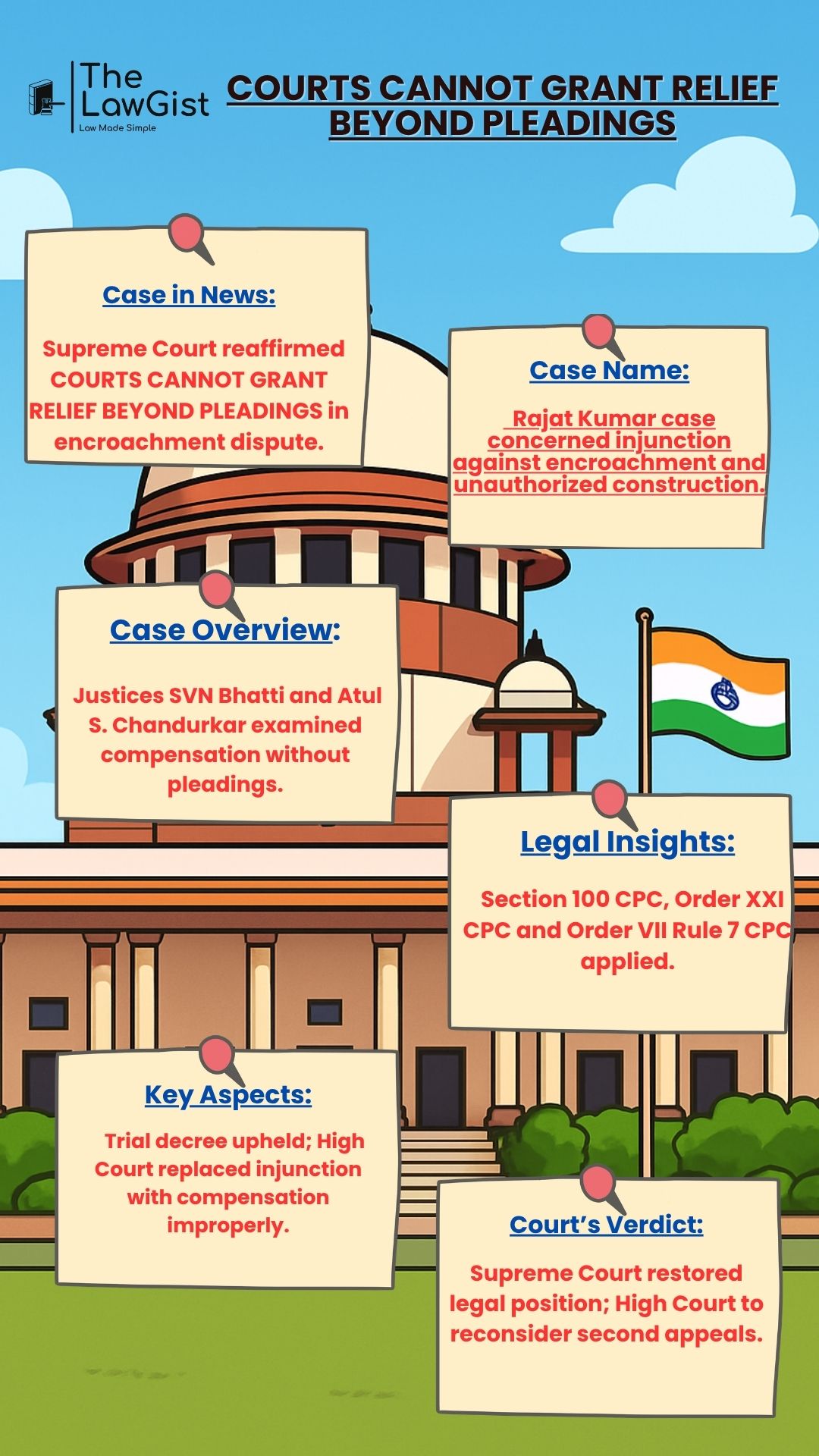
Courts Cannot Grant Relief Beyond Pleadings reaffirmed by the Supreme Court of India in an encroachment dispute.
Discover powerful Latin Maxims and simplify complex legal terms in seconds
Case Overview
Case Name- Rajat Kumar And Others Versus S D Adarsh Jain Kanya Maha Vidyalaya Sadhaura And Others
In this case a Bench of Justice SVN Bhatti & Justice Atul S. Chandurkar considered whether compensation could be awarded despite the absence of such a prayer in the plaint. The dispute related to alleged encroachments through a wall & lintel. While the Trial Court and 1st Appellate Court directed removal of the structures the Punjab and Haryana High Court substituted the injunction with compensation leading to appeals before the Supreme Court.
Key Aspects
The dispute revolved around the legality of granting compensation in place of an injunction. The case also examined the powers of the High Court in 2nd appeals & the scope of execution proceedings after setting aside a decree.
- Plaintiff sought removal of the encroaching wall & permanent injunction.
- Trial Court decreed removal of the structures & restrained further construction.
- First Appellate Court upheld the decrees.
- High Court, in second appeals replaced the injunction with monetary compensation.
- Legal heirs of the plaintiff challenged the order before the Supreme Court of India.
- The principal issue involved the doctrine of No Relief Beyond Pleadings.
Legal Insights
The judgment emphasizes that courts must confine themselves to the reliefs sought in the pleadings. It also clarifies the limits of appellate & executing courts under the Code of Civil Procedure, 1908.
- Section 100 of the Code of Civil Procedure, 1908 mandates that a High Court can decide a 2nd appeal only after framing substantial questions of law.
- Order XXI of the Code of Civil Procedure, 1908 governs execution proceedings & cannot operate in the absence of a subsisting decree.
- Under Order VII Rule 7 CPC relief granted by a court must be based on the pleadings & prayers made by the parties.
- A court cannot compel a litigant to accept damages or compensation when no such relief has been claimed.
- The principle of No Relief Beyond Pleadings safeguards procedural fairness & party autonomy.
Court’s Verdict
The Supreme Court of India set aside the Punjab and Haryana High Court’s judgment & held that compensation could not be forced upon the plaintiffs in the absence of any prayer for such relief. It further ruled that the Executing Court could not assess compensation without an executable decree & directed the High Court to reconsider the 2nd appeals on merits in accordance with Section 100 CPC expeditiously.
Source-Supreme Court of India
Read also-Code of Civil Procedure, 1908
The LawGist ensures exam success with quality notes—TPL, Current Affairs, Recent Judgments, and more. Backed by trusted resources and videos, The LawGist is every aspirant’s first choice