Supreme Court holds that Madhya Pradesh Special Police Establishment is not an intelligence and security organisation and cannot be exempted from the RTI Act under Section 24(4).
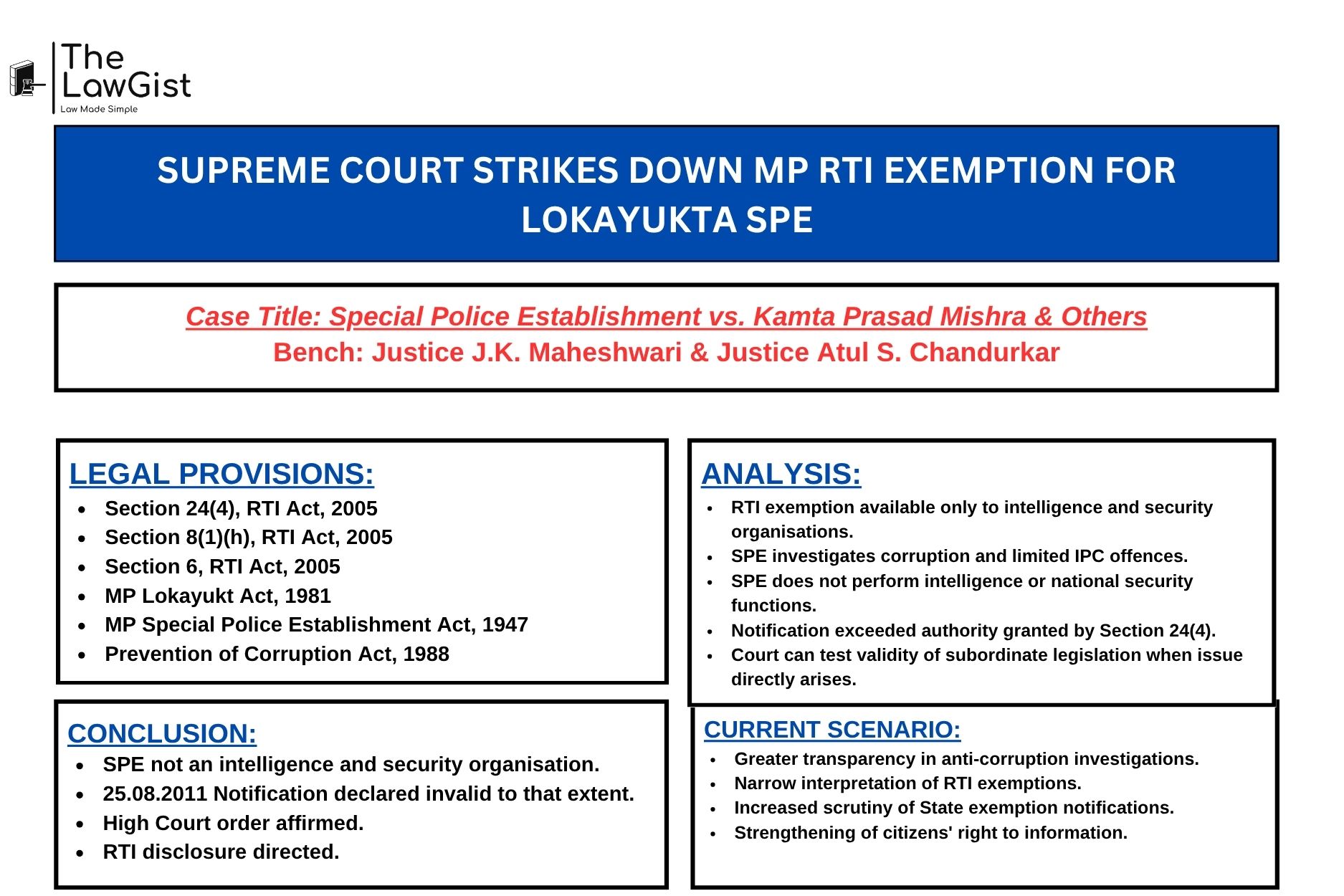
SUPREME COURT STRIKES DOWN MP RTI EXEMPTION FOR LOKAYUKTA SPE
CASE SUMMARY – The Supreme Court in Special Police Establishment vs. Kamta Prasad Mishra (2026) considered whether the Madhya Pradesh Special Police Establishment (SPE), functioning under the Lokayukta Organisation, could claim exemption from the Right to Information Act, 2005 under Section 24(4). The Court held that only intelligence and security organisations are entitled to such exemption. Since SPE primarily investigates corruption and related offences under the Prevention of Corruption Act and certain IPC provisions, it cannot be classified as an intelligence or security agency. Consequently, the Court struck down the 25.08.2011 notification granting exemption and upheld disclosure under RTI.
CASE ANALYSIS TABLE
| Heading | Details |
| Case Title | Special Police Establishment vs. Kamta Prasad Mishra & Others |
| Introduction | The Supreme Court examined whether the Madhya Pradesh Special Police Establishment (SPE) functioning under the Lokayukta Organisation could claim exemption from the Right to Information Act, 2005 under Section 24(4), which applies only to “intelligence and security organisations.” |
| Factual Background | Kamta Prasad Mishra, a Town Inspector, was trapped in a corruption case investigated by SPE under the Prevention of Corruption Act, 1988. After sanction for prosecution was granted, he sought information under the RTI Act regarding the sanction process and related communications. The request was denied relying on Section 8(1)(h) RTI Act and the MP Government Notification dated 25.08.2011 exempting SPE from RTI. The State Information Commission upheld the denial, but the Madhya Pradesh High Court directed disclosure. SPE appealed before the Supreme Court. |
| Legal Issues | 1. Whether SPE is an “intelligence and security organisation” under Section 24(4) RTI Act.
2. Whether Notification dated 25.08.2011 validly exempted SPE from RTI Act. 3. Whether information regarding prosecution sanction could be denied under Section 8(1)(h) RTI Act. 4. Whether the Court could examine validity of the notification suo motu despite absence of specific challenge. |
| Applicable Law | • Section 24(4), RTI Act, 2005
• Section 8(1)(h), RTI Act, 2005 • Section 6, RTI Act, 2005 • Madhya Pradesh Lokayukt Evam Up-Lokayukt Adhiniyam, 1981 • Madhya Pradesh Special Police Establishment Act, 1947 • Prevention of Corruption Act, 1988 |
| Analysis | The Court held that Section 24(4) applies only to intelligence and security organisations. Examination of the Second Schedule of the RTI Act showed entities involved in national intelligence and security. SPE’s jurisdiction was limited to investigating corruption-related offences under the Prevention of Corruption Act and specific IPC offences. Its functions related to anti-corruption inquiries, not intelligence gathering or security operations. Therefore, the State Government exceeded its authority by granting SPE blanket RTI exemption through the 2011 notification. The Court also reiterated that subordinate legislation can be tested for validity even without a specific challenge where the issue directly arises and affected parties are heard. |
| Conclusion | The Supreme Court struck down the Notification dated 25.08.2011 insofar as it exempted SPE from RTI Act applicability. SPE is not an “intelligence and security organisation” under Section 24(4). The High Court’s order directing disclosure of information was upheld and the appeal was dismissed. |
| Current Scenario | The judgment significantly strengthens transparency in anti-corruption investigations conducted by Lokayukta-linked agencies. RTI exemptions cannot be claimed merely because an agency investigates corruption. State Governments must ensure that exemptions under Section 24(4) are confined strictly to genuine intelligence and security organisations. The decision is likely to influence similar RTI exemption notifications across States and reinforce judicial scrutiny of subordinate legislation. |
“Transparency cannot be denied through statutory exemption unless the organisation genuinely falls within the category of intelligence and security agencies contemplated by law.”
SOURCE – SUPREME COURT OF INDIA