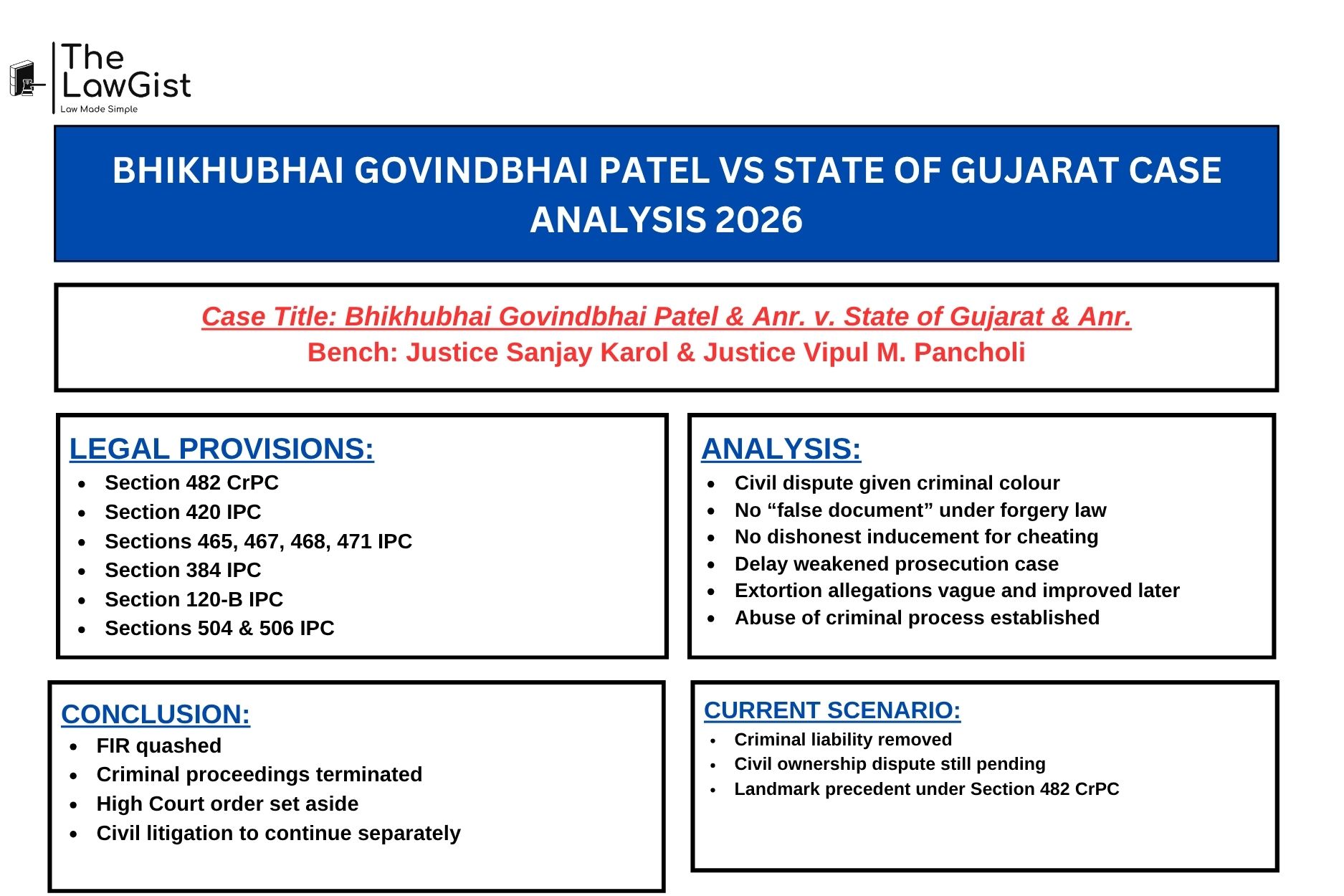
BHIKHUBHAI GOVINDBHAI PATEL VS STATE OF GUJARAT CASE ANALYSIS 2026
CASE SUMMARY – The Supreme Court in Bhikhubhai Govindbhai Patel & Anr. vs. State of Gujarat & Anr. quashed criminal proceedings arising from a long-standing ancestral property dispute. The Court held that the allegations of forgery, cheating, extortion, intimidation, and conspiracy lacked the essential ingredients required under the IPC. It observed that mere execution of documents claiming ownership does not amount to forgery and that the dispute was overwhelmingly civil in nature. The Court also noted the unexplained delay of nearly nine years in lodging the FIR and held that criminal law cannot be misused to harass parties involved in civil property litigation.
| ASPECTS | DETAILS |
| Case Title | Bhikhubhai Govindbhai Patel & Anr. vs. State of Gujarat & Anr. |
| Introduction | The Supreme Court examined whether criminal proceedings alleging forgery, cheating, extortion, intimidation, and conspiracy could continue when the dispute fundamentally arose from a long-standing civil property dispute. The Court analyzed the misuse of criminal law in civil litigation and the scope of powers under Section 482 CrPC. |
| Factual Background | The dispute concerned ancestral property bearing Survey No. 157 at Village Panas, Surat. Civil litigation regarding ownership had been pending since 2000. The appellants claimed ownership rights based on Urban Land Ceiling proceedings and revenue entries. Respondent No. 2 later lodged an FIR in 2009 alleging forgery, cheating, extortion, conspiracy, and intimidation relating to execution of a Power of Attorney and property transactions. The Gujarat High Court refused to quash the FIR, leading to the present appeals before the Supreme Court. |
| Legal Issues | 1. Whether the dispute was predominantly civil in nature.
2. Whether execution of documents claiming ownership amounted to forgery under IPC. 3. Whether ingredients of cheating and extortion were established. 4. Whether delayed FIR indicated mala fide prosecution. 5. Whether High Court erred in refusing quashing under Section 482 CrPC. |
| Applicable Law | Section 482 CrPC; Sections 420, 465, 467, 468, 471, 384, 504, 506, 511, and 120-B IPC; State of Haryana v. Bhajan Lal; Mohd. Ibrahim v. State of Bihar; Mohd. Wajid v. State of U.P.; Neeharika Infrastructure Pvt. Ltd. v. State of Maharashtra. |
| Analysis | The Supreme Court held that the dispute primarily related to civil ownership claims pending before competent civil courts. Mere execution of a document claiming ownership does not constitute forgery unless a “false document” under Section 464 IPC is created. The Court found no dishonest inducement or delivery of property necessary for cheating. Extortion allegations lacked details such as date, place, and actual delivery of money. The FIR was lodged after an unexplained delay of nearly 8–9 years, and allegations of extortion were introduced only in the later complaint, suggesting mala fide intent and abuse of criminal process. |
| Conclusion | The Supreme Court allowed the appeals and quashed FIR No. I-CR No. 504/2009 along with all consequential criminal proceedings against the appellants. The Court ruled that criminal proceedings cannot be used to pressure parties in a civil property dispute and held that the ingredients of alleged criminal offences were absent. |
| Current Scenario | Criminal proceedings against the appellants stand quashed. However, civil proceedings regarding ownership and title over the property continue independently before the competent civil courts. The judgment is now considered an important precedent concerning misuse of criminal law in civil disputes and the scope of Section 482 CrPC powers. |
“Criminal law cannot be permitted to become a weapon of harassment and coercion in disputes concerning title over immovable property.”
SOURCE – SUPREME COURT OF INDIA