SUPREME COURT ON INQUEST REPORTS AND BAIL IN MURDER CASE
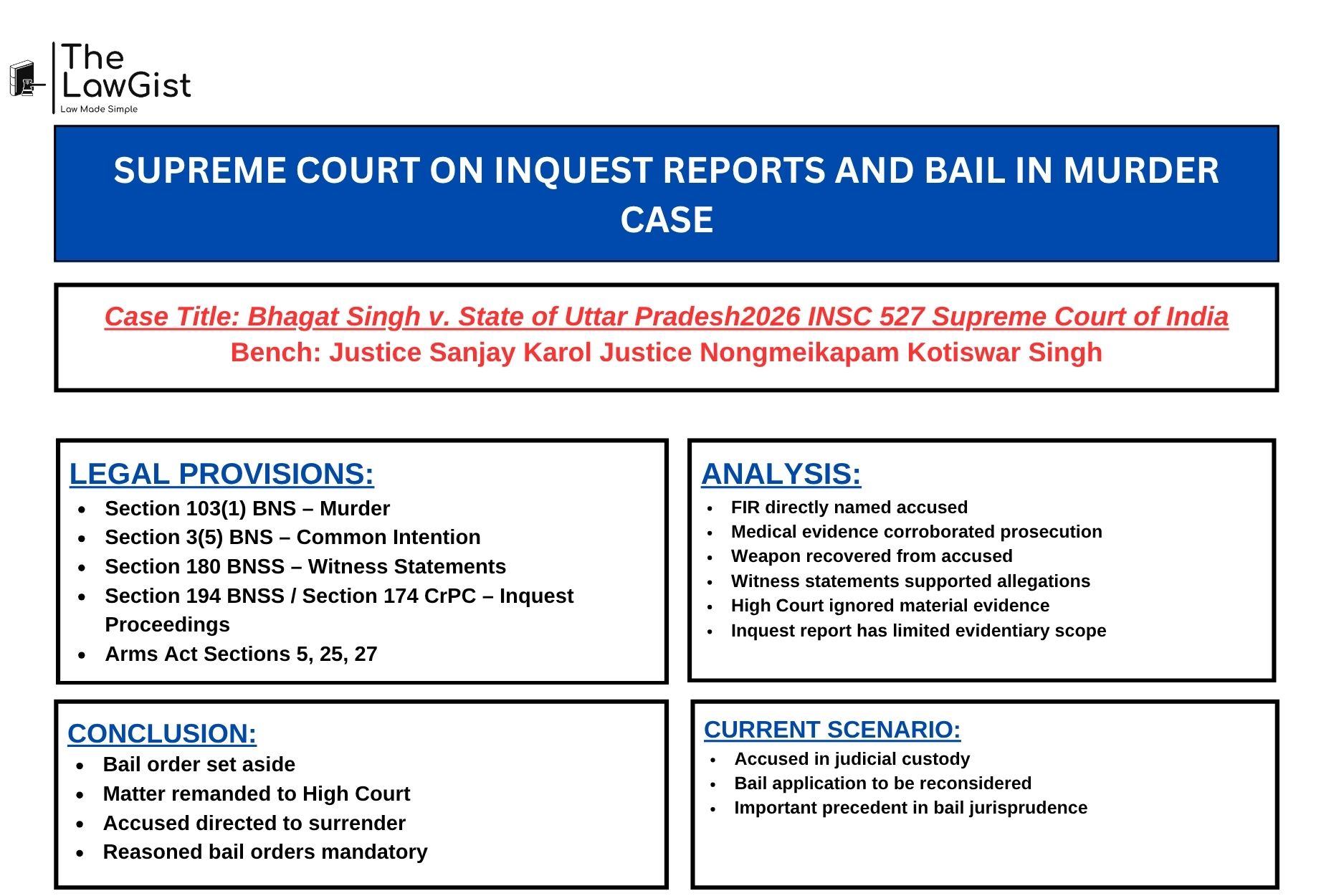
CASE SUMMARY – The Supreme Court in Bhagat Singh vs. State of Uttar Pradesh set aside an Allahabad High Court order granting bail to a murder accused. The Court held that the High Court failed to properly consider important evidence such as the FIR, witness statements, recovery of the weapon, and post-mortem report. It clarified that inquest proceedings under Section 174 CrPC and Section 194 BNSS are limited to determining the apparent cause of death and not identifying the accused. Therefore, omission of the accused’s name during inquest proceedings could not justify bail. The matter was remanded for fresh consideration.
| ASPECTS | DETAILS |
| Case Title | Bhagat Singh vs. State of Uttar Pradesh |
| Introduction | The Supreme Court of India examined whether the Allahabad High Court was justified in granting bail to an accused in a murder case by relying upon omissions in the inquest proceedings. The Court emphasized that bail orders in heinous offences must be reasoned and based on complete material evidence. |
| Factual Background | On 8 March 2025, Bharat Singh alias Pappu was allegedly murdered by Respondent No. 2 and two co-accused using country-made pistols. FIR No. 118 of 2025 was registered at Police Station Chhata, Mathura. A .315 bore pistol and spent cartridge were recovered at the instance of the accused. The Sessions Court rejected bail, but the Allahabad High Court later granted bail mainly because the accused’s name was absent during inquest proceedings. |
| Legal Issues | 1. Whether omission of the accused’s name in the inquest report weakens the prosecution case. 2. Whether the High Court ignored material evidence while granting bail. 3. Scope and evidentiary value of inquest proceedings under criminal law. |
| Applicable Law | Sections 103(1), 352, 351(2), and 3(5) of the Bharatiya Nyaya Sanhita, 2023; Section 180 and Section 194 BNSS; Section 174 CrPC; Sections 5, 25, and 27 of the Arms Act, 1959. |
| Analysis | The Supreme Court observed that the accused was specifically named in the FIR with direct allegations of firing at the deceased. The post-mortem report confirmed firearm injuries, and witness statements under Section 180 BNSS supported the prosecution case. The Court clarified that inquest proceedings are limited to identifying the apparent cause of death and not the identity of the accused. Therefore, the High Court erred in relying solely on omissions in the inquest report while ignoring other incriminating evidence. |
| Conclusion | The Supreme Court held that the High Court’s bail order was cryptic, unreasoned, and suffered from non-application of mind. The bail order was set aside and the matter was remanded to the Allahabad High Court for fresh consideration in accordance with law. |
| Current Scenario | The accused has been directed to surrender and remain in judicial custody until fresh orders are passed by the High Court. The judgment reinforces the principle that courts must consider the totality of evidence while deciding bail applications in serious offences. |
“Inquest proceedings are limited to determining the apparent cause of death and not the identity of the accused.”
SOURCE – SUPREME COURT OF INDIA