Supreme Court emphasizes strict compliance in EWS reservation eligibility criteria.
SUPREME COURT CLARIFIES STRICT COMPLIANCE RULE ON EWS CERTIFICATE VALIDITY
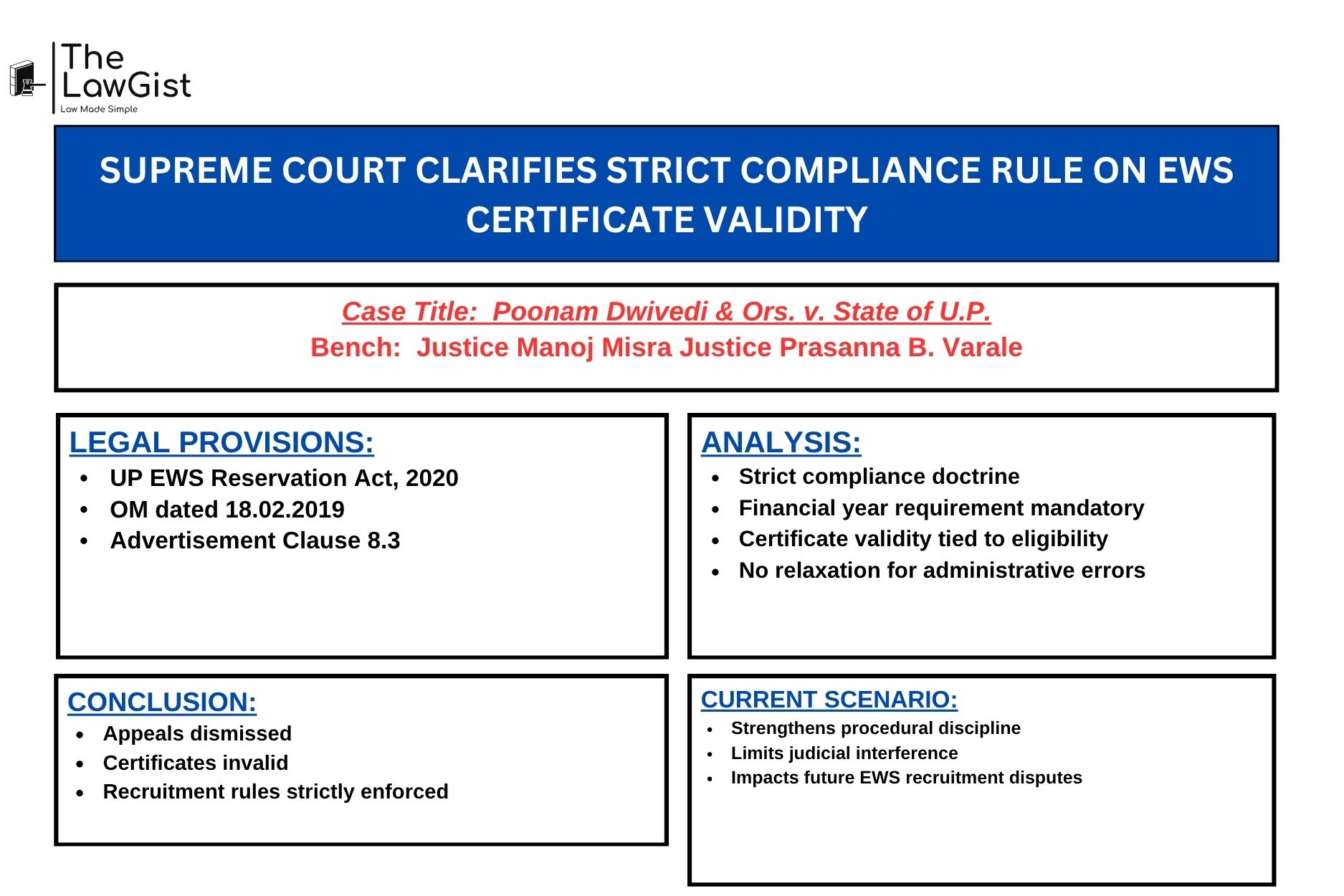
CASE SUMMARY – The Supreme Court in Poonam Dwivedi vs. State of U.P. (2026) held that EWS reservation claims must strictly comply with eligibility criteria prescribed in recruitment notifications. The Court ruled that income and asset certificates must correspond to the financial year preceding the application and must be valid as per the prescribed format. Certificates issued before the closure of the relevant financial year or relating to incorrect years were deemed invalid. The Court rejected arguments that candidates should not suffer due to administrative errors and upheld the High Court’s decision, emphasizing that procedural compliance is essential in large-scale public recruitment processes.
| ASPECTS | DETAILS |
| Case Title | Poonam Dwivedi & Ors. vs. State of U.P. & Ors., 2026 INSC 351 |
| Introduction | The case concerns eligibility for reservation under the Economically Weaker Section (EWS) category in a public recruitment process and validity of EWS certificates. |
| Factual Background | UPSSSC issued an advertisement (15.12.2021) for Health Worker posts. Candidates applied under EWS category but submitted defective or incorrect EWS certificates. Their candidature was rejected. The Single Judge allowed relief citing confusion, but Division Bench reversed it. Appeals were filed before the Supreme Court. |
| Legal Issues | 1. Whether EWS certificates not conforming to prescribed financial year are valid.
2. Whether candidates should suffer for errors by issuing authorities. |
| Applicable Law | – UP Public Services (Reservation for EWS) Act, 2020
– Office Memorandum dated 18.02.2019 – Clause 8.3 of Advertisement – Precedents: UPSC v. Gaurav Singh (2024); Divya v. Union of India (2024) |
| Analysis | The Court emphasized strict compliance with eligibility conditions. Certificates must relate to the financial year prior to application (2020–21). Certificates issued before closure of financial year or relating to incorrect years are invalid. Candidates had opportunity to obtain proper certificates. Administrative error does not cure eligibility defects. |
| Conclusion | Supreme Court upheld the High Court Division Bench decision and dismissed appeals. Invalid EWS certificates cannot be accepted. |
| Current Scenario | The ruling reinforces strict compliance in recruitment processes. Authorities and candidates must ensure accuracy in documentation. Courts are reluctant to interfere in large-scale recruitment errors. |
“Eligibility conditions in public recruitment must be strictly complied with, even if errors arise from administrative authorities.”
SOURCE – SUPREME COURT OF INDIA