Supreme Court rules ED can examine seized mobile phones, balancing Article 21 privacy with lawful PMLA investigation powers.
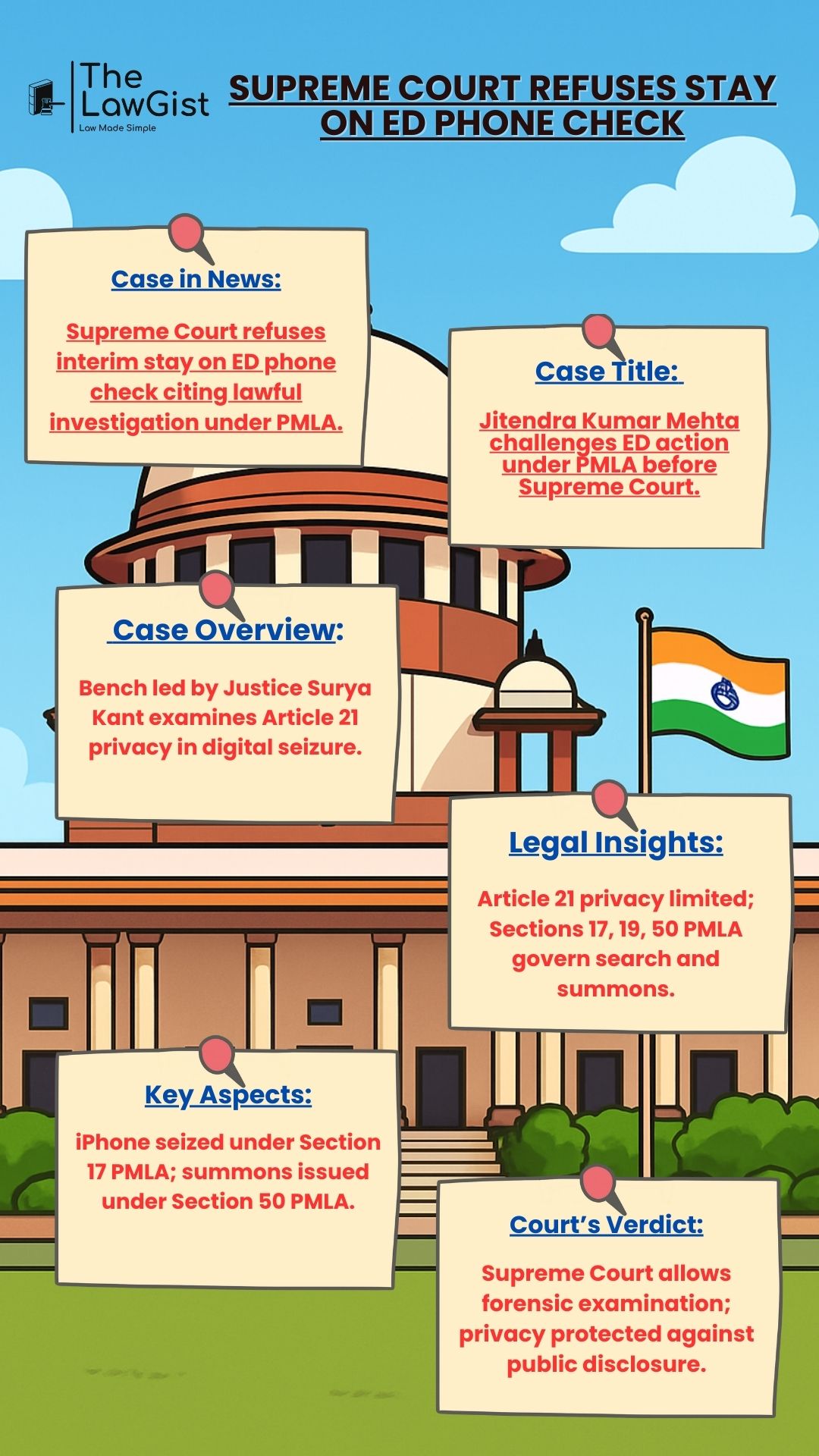
Case in NewsSupreme Court Refuses Stay on ED Phone Check, rejecting Article 21 privacy plea against phone examination . |
Discover powerful Latin Maxims and simplify complex legal terms in seconds.
Case Overview
Case Name: Jitendra Kumar Mehta vs. Directorate of Enforcement and Ors.
In Jitendra Kumar Mehta v. Directorate of Enforcement, the Supreme Court dealt with the legality of forensic examination of a seized mobile phone during a money laundering probe. The Bench comprising Justice Surya Kant, Justice Joymalya Bagchi & Justice Vipul Pancholi refused interim relief to the petitioner, a Kolkata businessman. He challenged the Enforcement Directorate’s action under the PMLA alleging violation of Article 21 and the Right to Privacy due to lack of safeguards governing access to digital data .
Step into the world of justice with Courtroom Chronicles
Key Aspects
The dispute arises from a search conducted by the ED and the subsequent seizure of the petitioner’s mobile device . The petitioner argued that unrestricted access to personal data would amount to a fishing inquiry . The Court, however examined the balance between individual privacy and the needs of lawful investigation .
- ED seized the petitioner’s iPhone during a search on 8th January 2026 .
- Summons were issued for forensic examination under Section 50 PMLA .
- No predicate offence was registered against the petitioner individually .
- Issue centred on whether digital examination violates privacy under Article 21 of Constitution of India .
Legal Insights
The Court analysed statutory powers under the PMLA alongside constitutional protections . It emphasised that privacy rights are not absolute and must yield to lawful investigation subject to safeguards .
- Article 21, Constitution of India – Protects life, personal liberty and the Right to Privacy, but permits reasonable restrictions .
- Section 17, PMLA – Authorises search and seizure based on “reason to believe”.
- Section 50, PMLA – Empowers ED to summon persons and require cooperation during investigation .
- Section 19, PMLA – Distinguished, as communication of reasons applies to arrest, not search .
Court’s Verdict
The Supreme Court refused to stay the forensic examination holding that a lawful investigation allows access to seized devices . Justice Surya Kant clarified that unrelated personal data cannot be disclosed or made public . Notice was issued, the matter was tagged with similar pending cases and interim protection against the Enforcement Directorate was declined .
Source – Supreme Court of India
Read also – Constitution of India
The LawGist ensures exam success with quality notes—TPL, Current Affairs, Recent Judgments, and more. Backed by trusted resources and videos, The LawGist is every aspirant’s first choice.