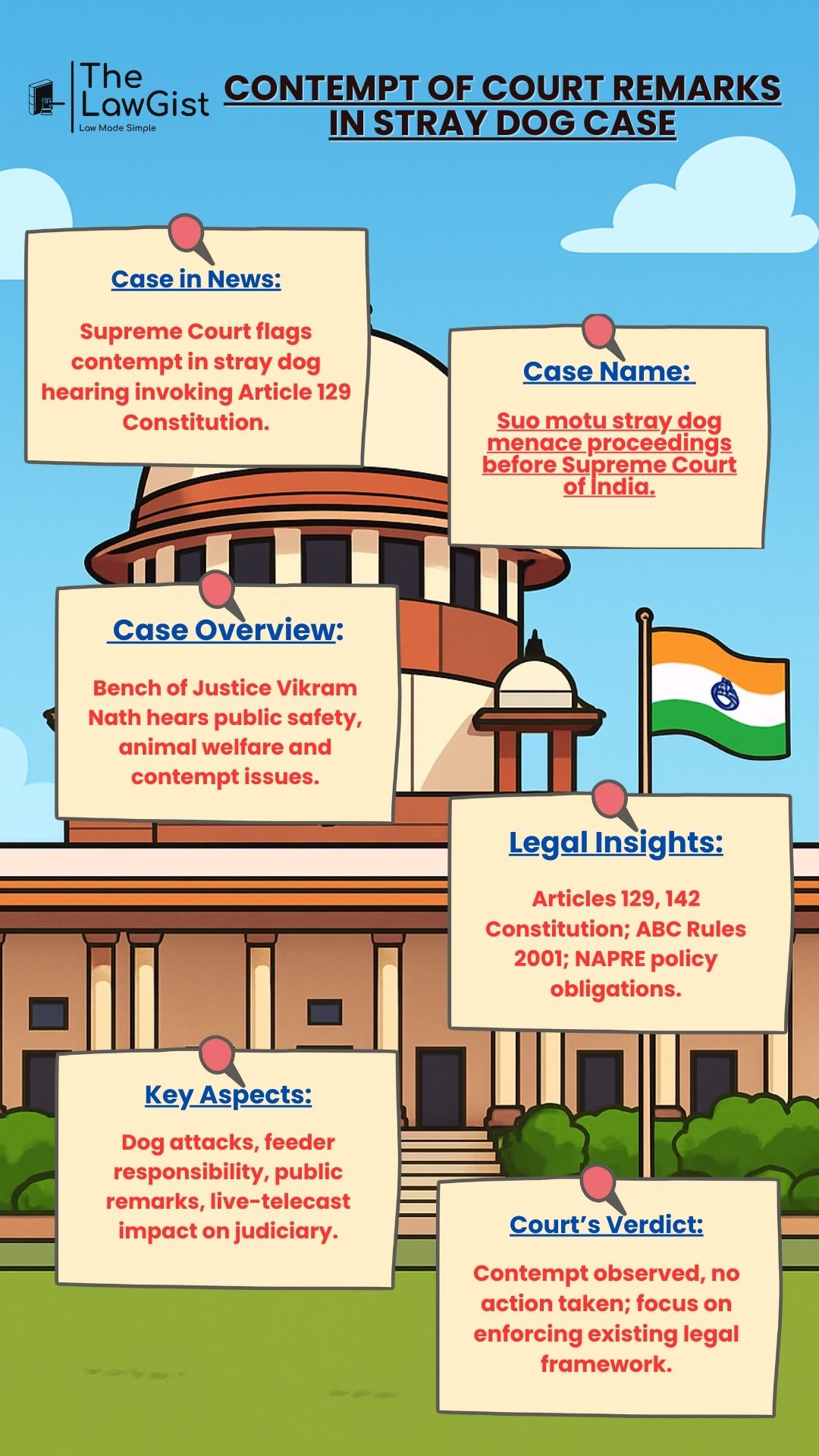
Case in NewsThe Supreme Court flagged contempt issues in the Contempt of Court Remarks in Stray Dog Case hearing . |
Discover powerful Latin Maxims and simplify complex legal terms in seconds.
Case Overview
The Supreme Court of India was hearing a suo motu matter concerning the growing menace of stray dog attacks across the country . A three-judge bench comprising Justice Vikram Nath, Justice Sandeep Mehta and Justice NV Anjaria examined issues of public safety, animal welfare and accountability of authorities . During the proceedings, the Court strongly criticised public comments made by former Union Minister Maneka Gandhi against judges observing that such remarks amounted to contempt of court, though no coercive action was initiated .
Step into the world of justice with Courtroom Chronicles
Key Aspects
The case highlights the tension between animal rights advocacy and citizens’ right to safety . The Court examined factual realities, policy failures and conduct of stakeholders involved in the stray dog debate .
- The matter arises from repeated incidents of stray dog attacks prompting suo motu intervention by the Supreme Court .
- Advocate Prashant Bhushan objected to certain oral observations made earlier citing risks of misreporting .
- The bench clarified that its remarks on fixing responsibility of dog feeders were serious and deliberate .
- Senior Advocate Raju Ramachandran appeared for Menaka Gandhi urging restraint due to live telecast of proceedings .
- The Court noted that Gandhi’s public statements against judges amounted to contempt .
Legal Insights
The Court analysed the issue through existing constitutional and statutory frameworks stressing enforcement over new policy creation .
- Article 129 of the Constitution of Indiaempowers the Supreme Court to punish for contempt of itself .
- Article 142 of the Constitution of India enables the Court to pass orders for complete justice .
- Animal Birth Control Rules, 2001, framed under the Prevention of Cruelty to Animals Act, 1960, govern stray dog population control.
- The National Action Plan for Rabies Elimination (NAPRE) places implementation responsibility on States and local bodies .
Court’s Verdict
The Supreme Court held that Maneka Gandhi’s remarks constituted contempt of court but refrained from initiating proceedings citing judicial magnanimity. The bench emphasised strict, time-bound implementation of existing legal frameworks and continued hearing arguments from all stakeholders. The matter is listed for further hearing on January 28 .
Source – Supreme Court
Read also – Constitution of India
The LawGist ensures exam success with quality notes—TPL, Current Affairs, Recent Judgments, and more. Backed by trusted resources and videos, The LawGist is every aspirant’s first choice.