The Supreme Court’s 2026 ruling in Gulfisha Fatima & Ors. vs. State (NCT of Delhi) draws a decisive legal line between central conspirators and ancillary accused in the Delhi riots case.
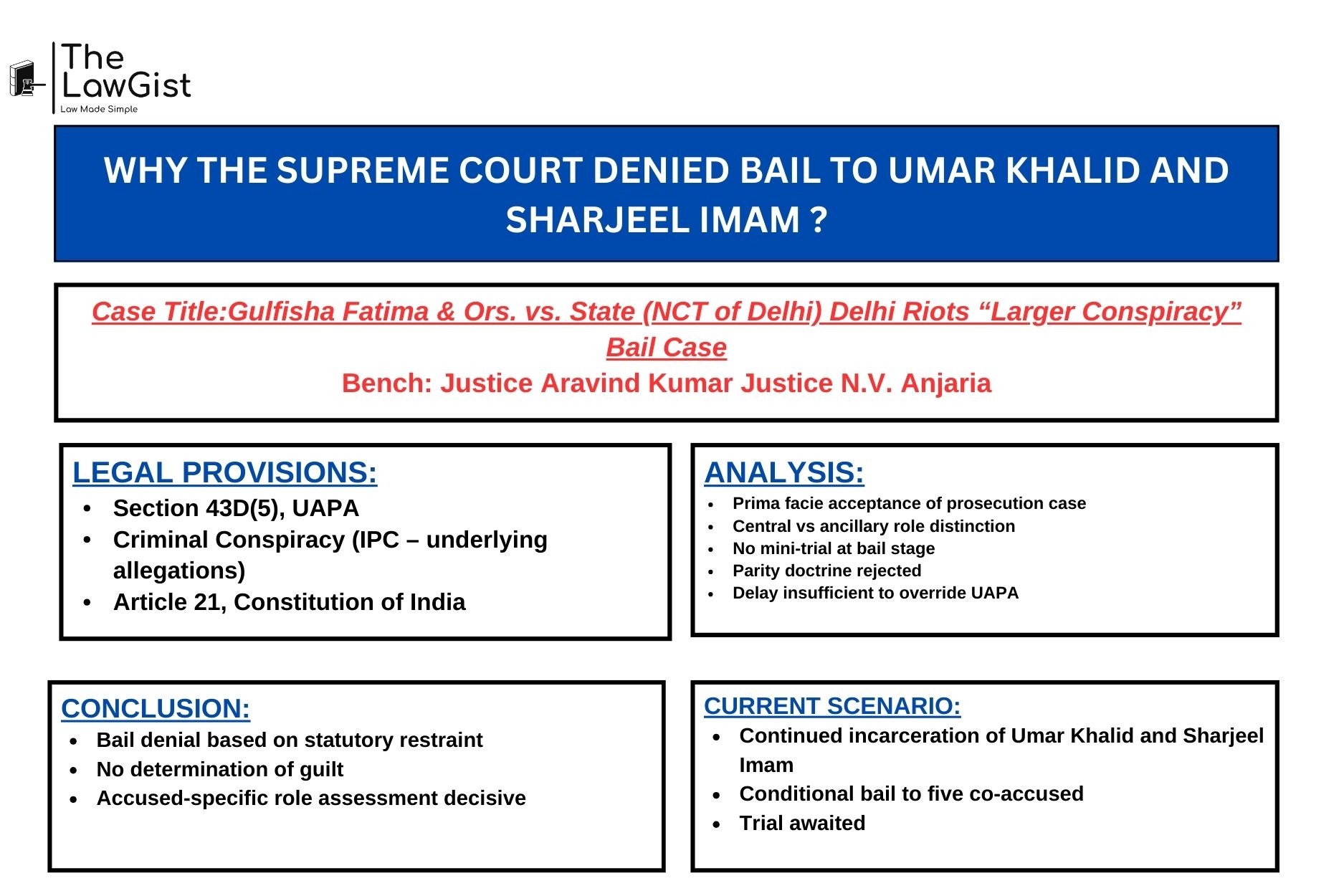
WHY THE SUPREME COURT DENIED BAIL TO UMAR KHALID AND SHARJEEL IMAM ?
CASE SUMMARY – In Gulfisha Fatima & Ors. vs. State (NCT of Delhi), decided on 5 January 2026, the Supreme Court of India ruled on bail applications arising from the Delhi riots “larger conspiracy” case. Applying Section 43D(5) of the UAPA, the Court denied bail to Umar Khalid and Sharjeel Imam, holding that the allegations against them disclosed a prima facie case of central conspiratorial roles involving planning and ideological leadership. Five co-accused were granted conditional bail due to their limited and ancillary roles. The judgment does not decide guilt but underscores the restrictive bail regime under UAPA.
| ASPECTS | DETAILS |
| Case Title | Gulfisha Fatima & Ors. vs. State (NCT of Delhi) |
| Introduction | On 5 January 2026, the Supreme Court of India delivered a common judgment in Gulfisha Fatima & Ors. v. State (NCT of Delhi), deciding multiple bail applications arising from the Delhi riots “larger conspiracy” case. While granting conditional bail to five accused, the Court denied bail to Umar Khalid and Sharjeel Imam, citing the gravity of allegations, their alleged central role, and statutory restrictions under the Unlawful Activities (Prevention) Act (UAPA). |
| Factual Background | The case arises from FIR No. 59/2020 related to the February 2020 Delhi riots, which resulted in 53 deaths and extensive damage to life and property. The Delhi Police alleged a pre-planned, multi-layered conspiracy connected to protests against the Citizenship (Amendment) Act (CAA), involving coordination meetings, speeches, and actions intended to escalate protests into communal violence. |
| Legal Issues |
|
| Applicable Law |
|
| Analysis | The Supreme Court undertook an accused-specific analysis and drew a clear distinction between those alleged to have played a “central and directive role” in the conspiracy and those whose involvement was described as limited or ancillary. The Court held that under UAPA, it could not conduct a mini-trial at the bail stage and was required to accept the prosecution case at face value for the purpose of determining prima facie truth. |
| Conclusion | Bail was denied to Umar Khalid and Sharjeel Imam not as a finding of guilt but due to the seriousness of allegations, their alleged central role, and the statutory mandate under UAPA. The Court reaffirmed that concerns of liberty, though important, cannot override legislative intent in cases involving public order and national security. |
| Current Scenario | As of January 2026, Umar Khalid and Sharjeel Imam remain in judicial custody, while five co-accused have been released on conditional bail. The trial in the larger conspiracy case is yet to commence and continues to draw significant public and legal scrutiny. |
“Bail under UAPA turns not on delay or parity, but on prima facie role and statutory restraint.”
SOURCE – SUPREME COURT OF INDIA
READ ALSO – Article 21 Constitution of India
Discover insighs on Latin Maxims and Legal Glossary and simplify complex legal terms in seconds.The LawGist ensures exam success with quality Blogs and Articles on — Top Legal Picks (TLP), Current Affairs, latest Supreme Court judgments as Courtroom Chronicles. Backed by trusted resources and videos, The LawGist is every Professionals and Aspirant’s first choice. Discover more at thelawgist.org