Supreme Court PIL highlights Tripura student Anjel Chakma’s death and urgent need to criminalise racial slurs as hate crimes.
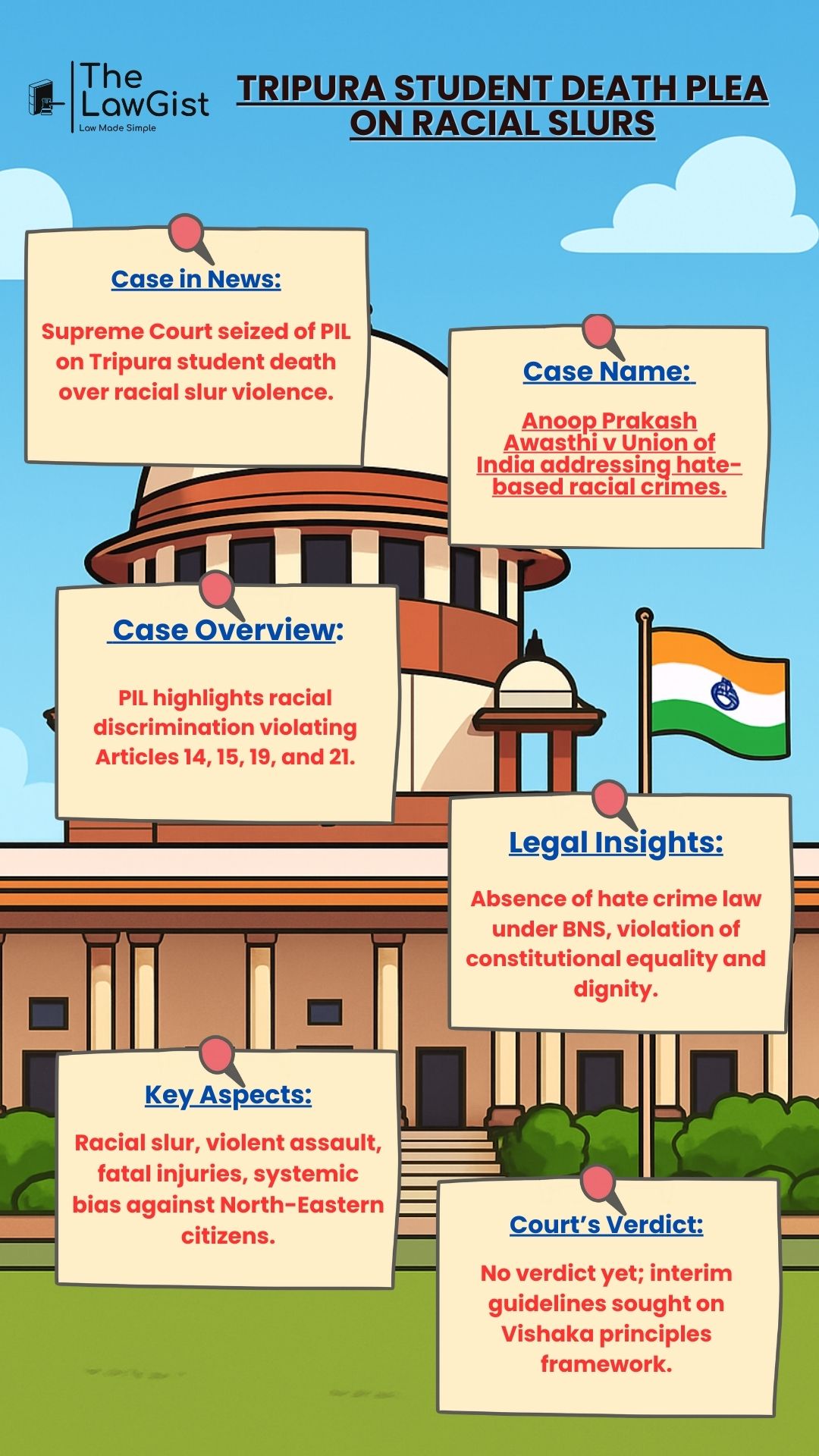
Case in NewsTripura student death plea on racial slurs highlights Supreme Court concern over rising racial discrimination . |
Discover powerful Latin Maxims and simplify complex legal terms in seconds.
Case Overview
Case Name: Anoop Prakash Awasthi Versus Union of India & Ors.
The public interest litigation before the Supreme Court stems from the death of Anjel Chakma, a 24-year-old MBA student from Tripura allegedly attacked in Dehradun due to his North-Eastern appearance . Filed by Advocate-on-Record Anoop Prakash Awasthi, the plea exposes the absence of a legal framework to deal with racially motivated crimes in India . It seeks judicial intervention to recognise hate crimes and racial slurs as distinct punishable offences . The matter is presently pending consideration before the Supreme Court of India .
Step into the world of justice with Courtroom Chronicles
Key Aspects
The case brings to the forefront the lived realities of racial discrimination faced by citizens from North-Eastern states . It underlines how everyday verbal abuse often escalates into serious violence due to lack of deterrent mechanisms and institutional sensitivity .
- Anjel Chakma and his brother were subjected to racial slur and Derogatory Remark targeting their appearance .
- The victims were allegedly assaulted after asserting their Indian citizenship .
- Chakma suffered grievous injuries to his neck and spine and died after prolonged ICU treatment .
- The incident reflects a broader pattern of racial violence against North-Eastern citizens across India .
Legal Insights
The petition argues that racially motivated violence strikes at the core of constitutional morality and fraternity . It stresses that existing criminal law fails to capture the bias-driven nature of such offences .
- Article 14 – It is in Constitution of India, Equality before law violated by selective targeting based on ethnicity .
- Article 15(1) – Prohibition of discrimination on grounds of race and place of birth .
- Article 19(1)(d) – Restriction on free movement due to fear of racial attacks .
- Article 21 – Right to life and dignity infringed by hate-based violence .
- Absence of hate crime recognition under Bharatiya Nyaya Sanhita, 2023 highlighted .
Court’s Verdict
No final verdict has been pronounced . The petitioner seeks interim guidelines akin to Vishaka v. State of Rajasthan, creation of nodal agencies and special police units and mandatory recording of racial motive, pending enactment of comprehensive legislation against Racial Discrimination .
Source – Supreme Court of India
Read also – Constitution of India
The LawGist ensures exam success with quality notes—TPL, Current Affairs, Recent Judgments, and more. Backed by trusted resources and videos, The LawGist is every aspirant’s first choice.