Supreme Court of India stays Aravalli mining verdict, seeking expert review on environmental impact and mining regulation.
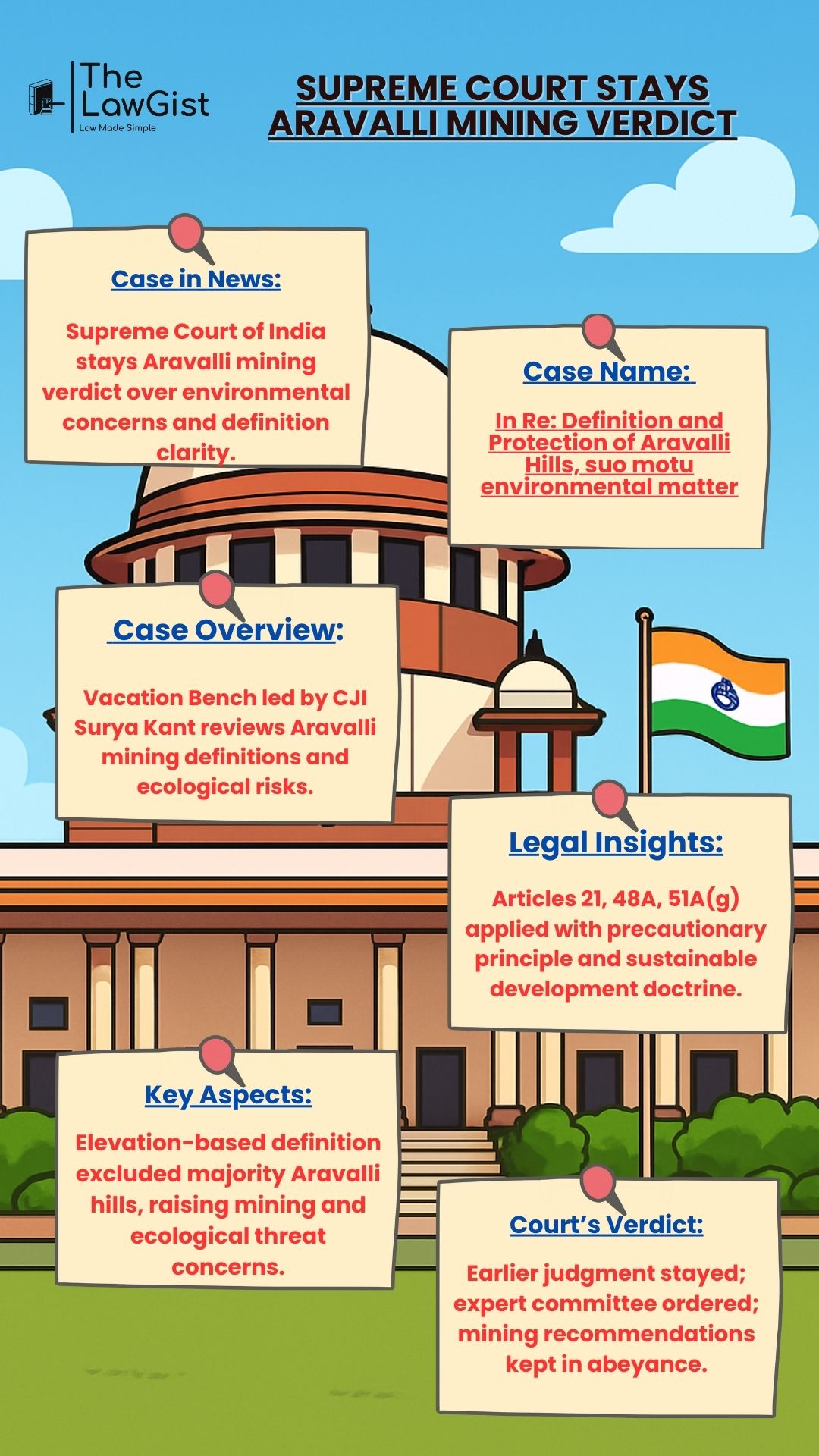
Case in NewsSupreme Court stays Aravalli mining verdict amid protests seeking clarity on environmental implications and definitions . |
Discover powerful Latin Maxims and simplify complex legal terms in seconds.
Case Overview
Case Name: In Re: Definition and Protection of Aravalli Hills (Suo Motu)
The Supreme Court of India, sitting as a Vacation Bench comprising CJI Surya Kant, Justice JK Maheshwari and Justice Augustine George Masih examined serious concerns surrounding the protection of the Aravalli mountain range . The Court initiated suo motu cognizance following nationwide protests against its earlier judgment dated November 20, 2025 which had accepted committee recommendations redefining Aravalli hills for mining regulation . The Union government was represented by Solicitor General Tushar Mehta . The Court found ambiguities in the earlier ruling and stressed the need for independent expert assessment .
Step into the world of justice withCourtroom Chronicles
Key Aspects
Before delving into the factual issues, the Court acknowledged the ecological sensitivity of the Aravalli range and the potential long-term consequences of regulatory dilution . The matter raised concerns over balancing development with environmental preservation .
- Earlier approval of an elevation-based definition for Aravalli landforms .
- Over 90% of the Aravalli region allegedly excluded from mining protection .
- Public protests alleging increased mining vulnerability .
- Conflicting definitions adopted by States across Delhi, Haryana, Rajasthan and Gujarat .
- Proposal to constitute an independent expert committee to reassess impacts .
Legal Insights
The Court examined constitutional and environmental principles governing ecological protection . These provisions guide judicial oversight over mining and environmental governance .
- Article 21, Constitution of India: Right to life includes the right to a clean and healthy environment .
- Article 48A, Directive Principles: State obligation to protect and improve forests and wildlife .
- Article 51A(g), Fundamental Duties: Citizen’s duty to safeguard natural resources .
- Precautionary Principle & Sustainable Development: Core doctrines under Indian environmental jurisprudence.
Conclusion
The Court stayed its earlier judgment and committee recommendations, keeping them in abeyance . It directed the formation of an independent expert committee to evaluate ecological consequences of regulated mining . Notices were issued to the Union and States and the matter was listed for final hearing on January 21, 2026 .
Source – Supreme Court of India
Read also – Constitution of India
The LawGist ensures exam success with quality notes—TPL, Current Affairs, Recent Judgments, and more. Backed by trusted resources and videos, The LawGist is every aspirant’s first choice.