Supreme Court safeguards privacy while limiting judicial use of DNA tests in R. Rajendran v. Kamar Nisha (2025).
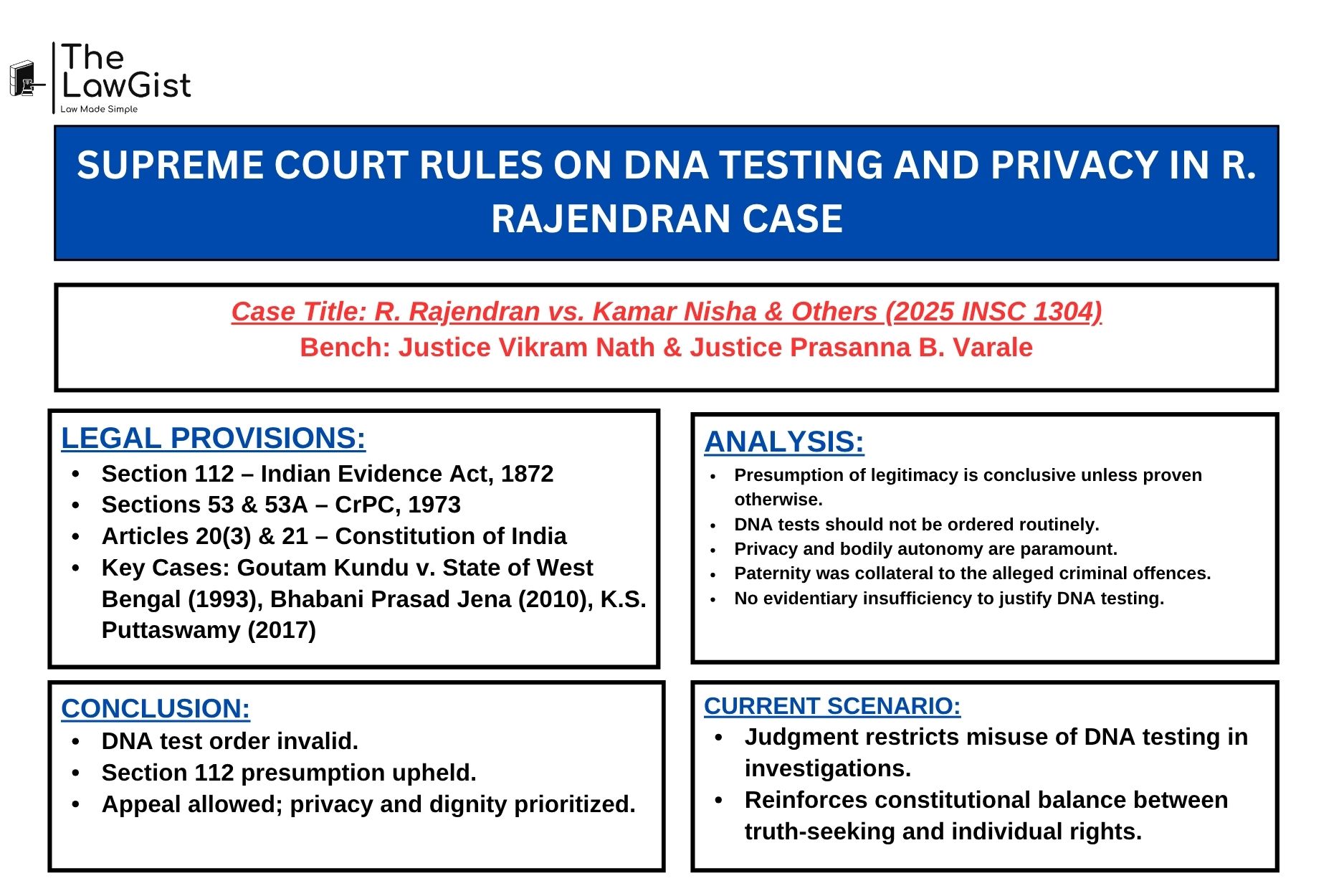
SUPREME COURT RULES ON DNA TESTING AND PRIVACY IN R. RAJENDRAN CASE
CASE SUMMARY – The Supreme Court in R. Rajendran vs. Kamar Nisha & Ors. (2025 INSC 1304) held that compelling DNA tests without proven non-access violates privacy under Article 21. The case arose when a doctor was accused of impregnating a patient’s wife. The Madras High Court ordered DNA profiling to confirm paternity. The Court ruled that Section 112 of the Evidence Act provides conclusive legitimacy to children born during a valid marriage, and no evidence of non-access existed. It set aside the High Court’s order, emphasizing that DNA testing cannot be used as a fishing tool and privacy must prevail over speculative inquiry.
| ASPECTS | DETAILS |
| Case Title | R. Rajendran vs. Kamar Nisha and Others |
| Introduction | The appeal challenged a Madras High Court order directing the appellant, a doctor, to undergo DNA testing to determine paternity in a criminal case under Sections 417 and 420 IPC and the Tamil Nadu Women Harassment Act. |
| Factual Background | Respondent No.1, married to Abdul Latheef, alleged that the appellant, her husband’s doctor, developed physical relations with her leading to the birth of a child. She later filed an FIR after a media appearance. The High Court ordered DNA testing to determine the child’s paternity. |
| Legal Issues | Whether the High Court was justified in compelling the appellant to undergo DNA testing under the circumstances. |
| Applicable Law | |
| Analysis | The Court reiterated that the presumption of legitimacy under Section 112 is conclusive unless non-access is proved. DNA testing cannot be ordered casually or to conduct roving inquiries. The right to privacy and dignity under Article 21 protects individuals from being compelled to undergo such invasive tests without eminent need. |
| Conclusion | The Supreme Court set aside the High Court’s order. It held that the statutory presumption of legitimacy remains unrebutted, DNA testing was unnecessary, and compelling it would violate privacy and bodily autonomy. |
| Current Scenario | The appeal was allowed on 10 November 2025. The judgment reaffirms strict limits on DNA testing orders and strengthens the constitutional protection of privacy in personal and criminal matters. |
“Scientific procedures, however advanced, cannot be employed as instruments of speculation; they must be anchored in demonstrable relevance to the charge.”
SOURCE – SUPREME COURT OF INDIA
READ ALSO –
Discover insighs on Latin Maxims and Legal Glossary and simplify complex legal terms in seconds.The LawGist ensures exam success with quality Blogs and Articles on — Top Legal Picks (TLP), Current Affairs, latest Supreme Court judgments as Courtroom Chronicles. Backed by trusted resources and videos, The LawGist is every Professionals and Aspirant’s first choice. Discover more at thelawgist.org