Supreme Court orders fencing of schools, hospitals, and public areas to prevent stray dog entry and mandates sterilization and sheltering under Animal Birth Control Rules, 2023.
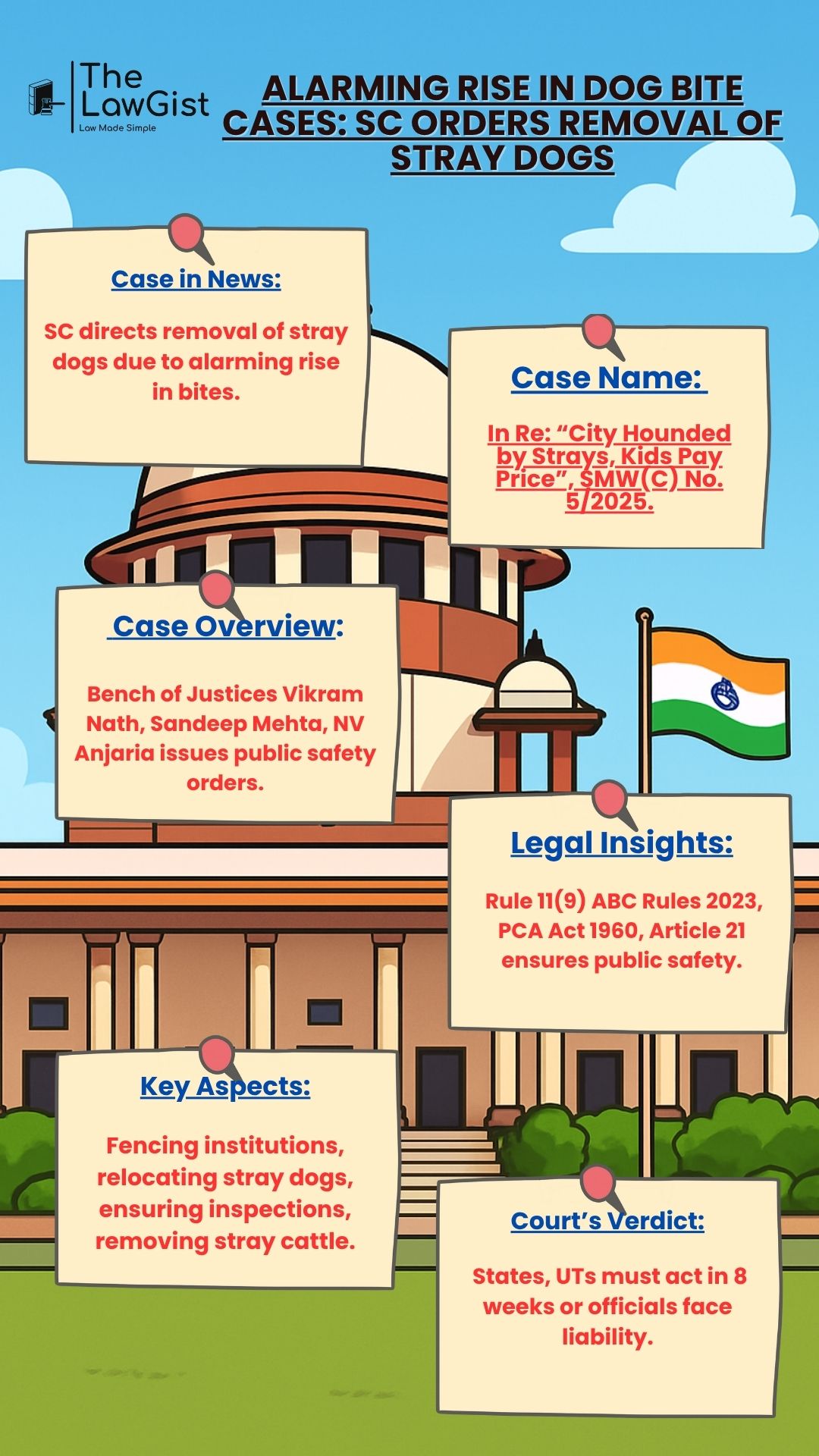
Case in NewsAlarming rise in dog bite cases: SC orders removal of stray dogs from schools, hospitals and public spaces across India . |
Discover powerful Latin Maxims and simplify complex legal terms in seconds.
Case Overview
Case Name: In Re: “City Hounded by Strays, Kids Pay Price”, SMW(C) No. 5/2025
A three-judge bench of the Supreme Court of India, consisting of Justice Vikram Nath, Justice Sandeep Mehta and Justice NV Anjaria, passed comprehensive directions after noticing an alarming surge in dog bite incidents across the country . The suo motu case was initiated following a Times of India report highlighting the increasing attacks, especially involving children . The Court stressed the need for strict preventive measures by local authorities to safeguard public spaces like schools, hospitals and transport hubs.
Step into the world of justice with Courtroom Chronicles
Key Aspects
The Court, while addressing the growing menace of stray dogs, laid down specific measures to ensure public safety and responsible animal management . The following are the main facts and issues raised :
- All educational institutions, hospitals, bus stands and railway stations must be properly fenced to prevent the entry of stray dogs .
- Local bodies are required to identify such premises within two weeks and carry out inspections every three months .
- Stray dogs must be picked, vaccinated, sterilized and relocated to designated shelters instead of being released back to the same areas .
- The Court also ordered the removal of stray cattle from roads and highways directing that they be shifted to goshalas or shelters .
Legal Insights
The judgment not only ensures public safety but also upholds statutory and constitutional mandates . The directions were framed in light of the following legal provisions :
- Animal Birth Control Rules, 2023 – particularly Rule 11(9), which governs sterilization, vaccination and controlled release of stray dogs .
- Prevention of Cruelty to Animals Act, 1960 – mandates humane treatment and regulation of animals by municipal authorities .
- Article 21 of the Constitution of India – guarantees the right to life and personal safety, which includes protection from animal attacks .
- Article 48A of the Constitution – obliges the State to protect and improve the environment and safeguard wildlife .
- The Animal Welfare Board of India (AWBI) was directed to issue Standard Operating Procedures (SOPs) within four weeks for uniform implementation .
Court’s Verdict
The Supreme Court of India directed all State Governments and Union Territories to secure public institutions and ensure removal of stray dogs from their premises within eight weeks . It warned that any failure to comply would attract personal accountability of officials . The Court emphasized that allowing stray dogs to reoccupy institutional areas would defeat the purpose of its directions, underscoring the urgency of nationwide compliance to curb the rising menace .
Source – Supreme Court of India
Read also – Constitution of India
The LawGist ensures exam success with quality notes—TPL, Current Affairs, Recent Judgments, and more. Backed by trusted resources and videos, The LawGist is every aspirant’s first choice.