Supreme Court urges Centre to consider penalising stubble burning to curb Delhi-NCR pollution while protecting farmers’ livelihood.
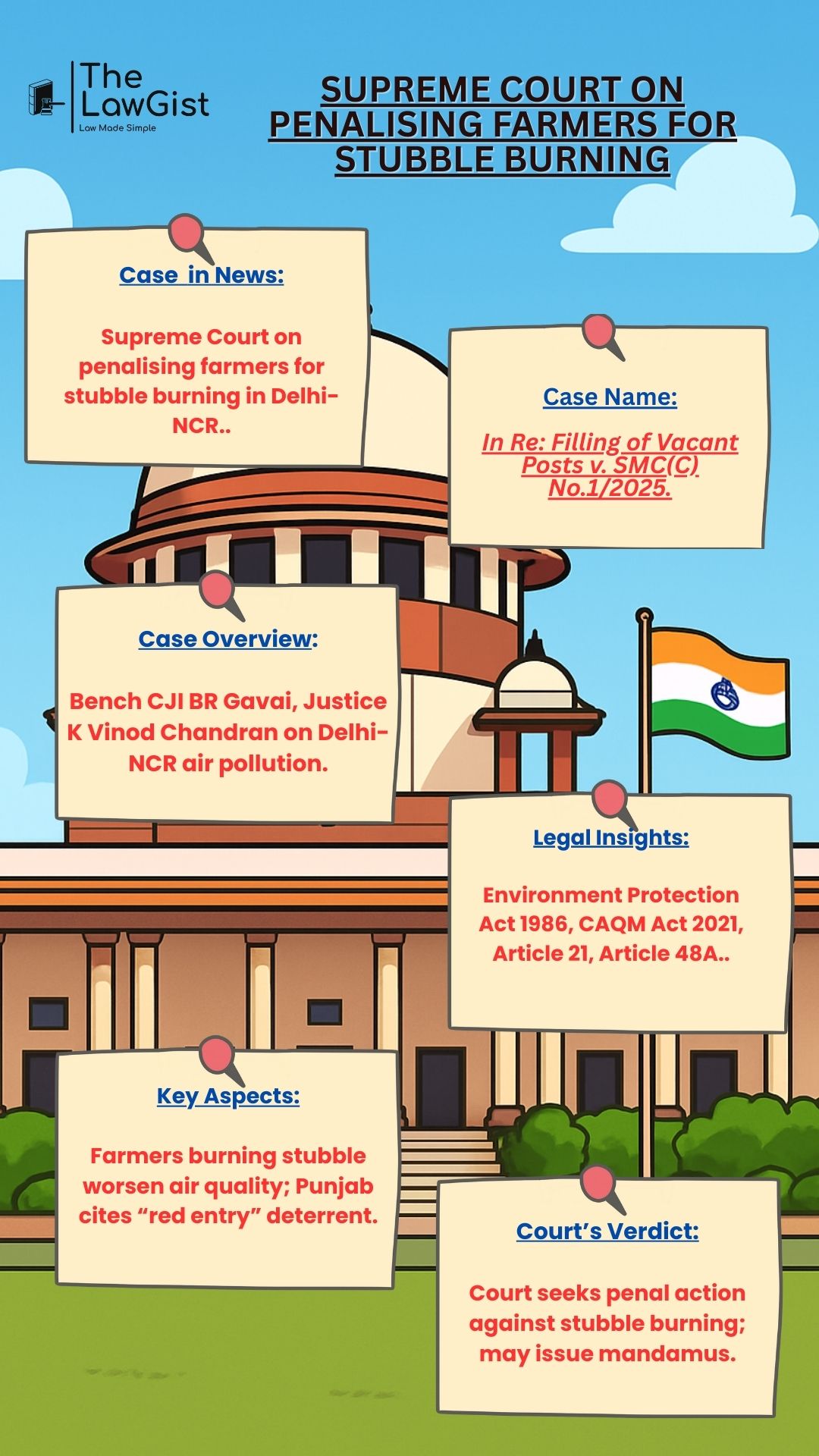
Case in NewsSupreme Court On Penalising Farmers For Stubble Burning highlights CJI’s concern over deterrent penal provisions . |
Discover powerful Latin Maxims and simplify complex legal terms in seconds.
Case Overview
The Supreme Court of India led by CJI BR Gavai and Justice K Vinod Chandran, examined the issue of Air Pollution in Delhi-NCR caused by Stubble Burning . During the hearing, the Court questioned the absence of specific penal provisions under the Environment Protection Act, 1986 while the CAQM Act, 2021 imposes liability only on erring officials .
Step into the world of justice with Courtroom Chronicles
Key Aspects
The Court noted that stubble burning continues to be a major factor in Delhi-NCR pollution . It engaged with the Centre and the State of Punjab on whether penal provisions should directly target farmers .
- Farmers’ stubble burning is a recurring cause of severe winter pollution in Delhi-NCR .
- The Union clarified that withdrawal of prosecutions was due to national policy favouring farmers .
- Punjab argued that prosecuting small farmers harms livelihoods; “red entry” mechanism acts as deterrent .
- Amicus curiae noted farmers burn stubble due to shorter crop cycles after delayed sowing .
Legal Insights
The Court also analysed the applicable legal provisions stressing the need for balance between environmental protection and farmers’ rights .
- Environment Protection Act, 1986 (Sections 15 & 16) : Provides for penalties but no direct mention of stubble burning .
- CAQM Act, 2021 (Sections 12 & 15) : Penalises officers failing to act but leaves gap regarding farmers’ liability .
- Article 21, Constitution of India : Ensures right to life and clean environment for citizens.
- Article 48A, Directive Principles : Mandates State to protect and improve environment .
- Supreme Court’s Power under Article 32: Can issue mandamus to enforce environmental safeguards .
Court’s Verdict
The Supreme Court asked the Centre to consider penalising stubble burning as a deterrent against pollution while balancing farmers’ livelihood concerns . The Court warned it may issue a mandamus if the Union fails to address the issue .
Source – Supreme Court of India
Read also – Constitution of India
The LawGist ensures exam success with quality notes—TPL, Current Affairs, Recent Judgments, and more. Backed by trusted resources and videos, The LawGist is every aspirant’s first choice. Discover more at thelawgist.org.