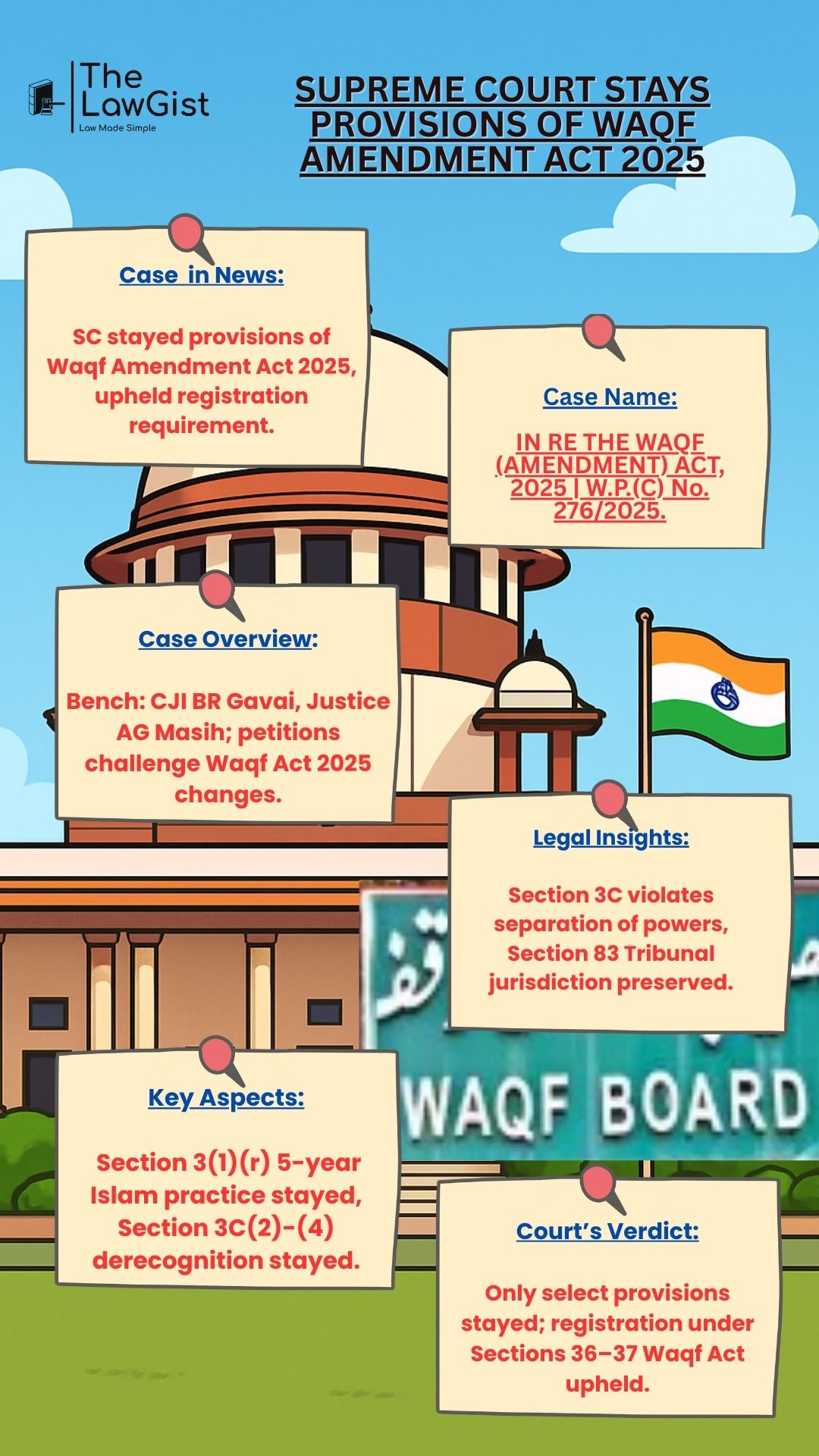
Supreme Court’s interim order on Waqf Amendment Act 2025 balances state powers with waqf autonomy.
Case in NewsSupreme Court stays provisions of Waqf Amendment Act 2025 while refusing to interfere with registration requirement . |
Discover powerful Latin Maxims and simplify complex legal terms in seconds.
Case Overview
Case Name: IN RE THE WAQF (AMENDMENT) ACT, 2025 | W.P.(C) No. 276/2025
The Supreme Court of India, on September 14, 2025 delivered an interim order on petitions challenging the Waqf Amendment Act 2025 . The bench led by Chief Justice BR Gavai and Justice AG Masih, addressed several contentious provisions while upholding others . The petitions, filed by leaders such as Asaduddin Owaisi, Mahua Moitra, AIMPLB and others, question the constitutionality of sweeping changes in waqf laws .
Step into the world of justice with Courtroom Chronicles.
Key Aspects
The Court examined the practical implications of the amendments and noted that some provisions could result in arbitrariness or breach of judicial safeguards . Therefore, only those provisions directly affecting fairness and property rights were stayed at this stage .
- Stayed the 5-year Islamic practice requirement for creating waqf until state rules are framed .
- Provisions empowering the Government officer/Collector to derecognize waqf land during disputes were stayed .
- Non-Muslim representation capped at 4 in Central Waqf Council and 3 in State Waqf Boards .
- Non-Muslim CEOs allowed, but preference suggested for Muslims .
- No interference with registration requirement and other major restrictions like abolition of waqf-by-user .
Legal Insights
The Court relied on constitutional guarantees of equality, separation of powers and statutory safeguards under the Waqf Act, 1995 (as amended) . It stressed that interim protection must balance state authority with waqf autonomy .
- Section 3(1)(r) – Stayed under Article 14, since no mechanism exists to determine 5-year Islamic practice .
- Sections 3C(2)-(4) – Stayed for violating basic doctrine of separation of powers, as title disputes must be decided by the Waqf Tribunal under Section 83, not the Collector .
- Sections 9 & 14 – Non-Muslim representation restricted ensuring the waqf character of Central and State Boards .
- Section 23 – Provision permitting non-Muslim CEO upheld, but Court directed preference for Muslim appointees .
- Registration under Sections 36–37 – Upheld as consistent with past practice (1995–2013) and not arbitrary .
Court’s Verdict
The Court ruled that legislation can rarely be stayed in entirety . Only select provisions of the Waqf Amendment Act 2025 were suspended to maintain balance until final hearing . The Court emphasized that registration of waqfs remains mandatory and no third-party rights can be created over disputed properties pending adjudication .
Source – Supreme Court of India
Read also – WAQF (AMENDMENT) BILL 2024- LEGAL IMPLICATIONS
The LawGist ensures exam success with quality notes—TPL, Current Affairs, Recent Judgments, and more. Backed by trusted resources and videos, The LawGist is every aspirant’s first choice. Discover more at thelawgist.org.