Supreme Court stresses need for wheelchair accessible Cab-Taxi services nationwide to ensure mobility rights of persons with disabilities under the RPwD Act.
Case in News
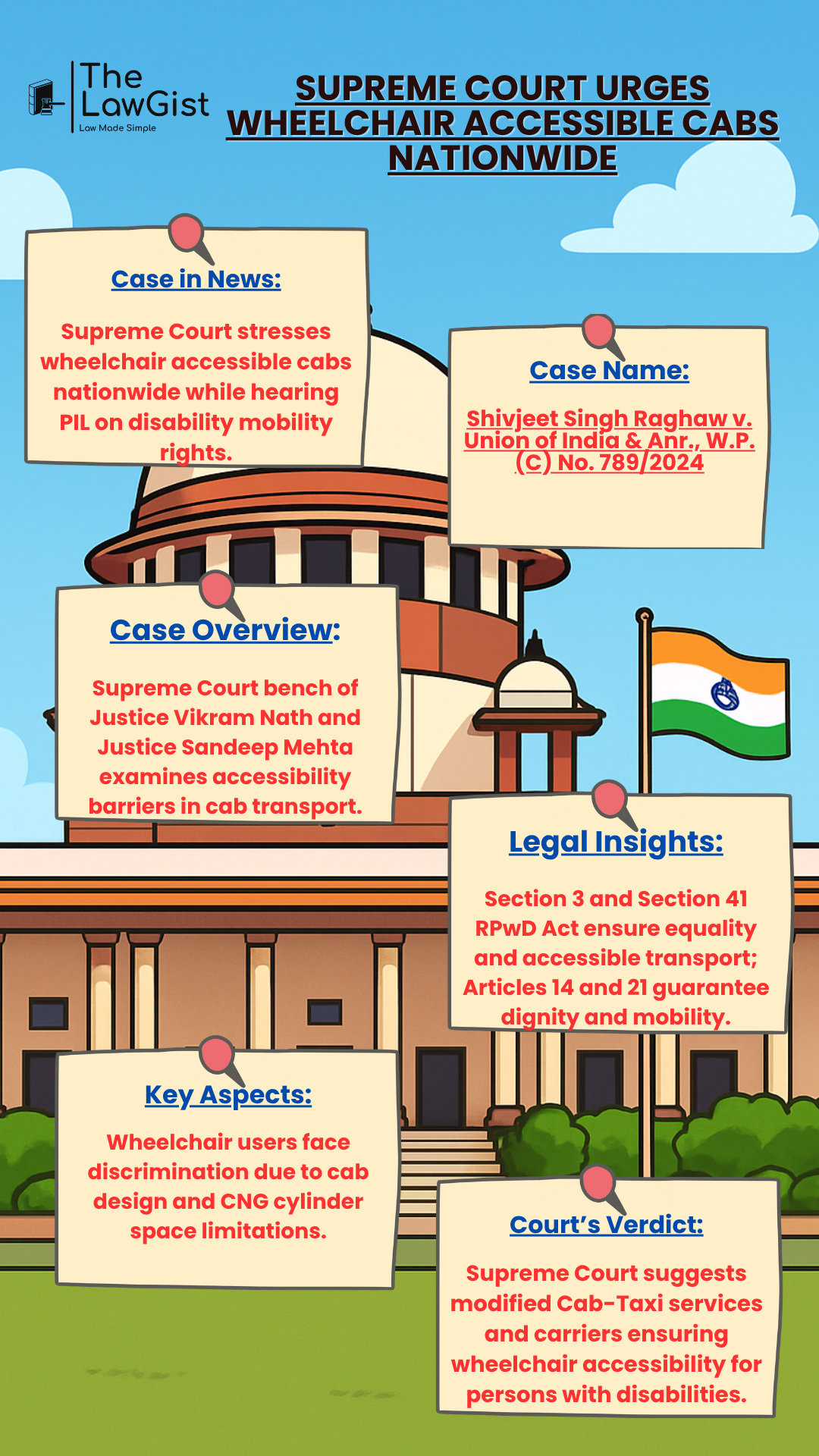
Supreme Court Urges Wheelchair Accessible Cabs Nationwide while hearing PIL seeking accessibility in cab services for persons with disabilities.
Discover powerful Latin Maxims and simplify complex legal terms in seconds
Case Name
Shivjeet Singh Raghaw v. Union of India & Anr., W.P.(C) No. 789/2024
Case Overview
The Supreme Court of India emphasised recently the importance of accessible transportation while hearing a Public Interest Litigation (PIL) related to mobility rights of persons with disabilities. The case was heard by a bench comprising Justice Vikram Nath & Justice Sandeep Mehta.
The petitioner showcases the practical challenges faced by persons with disabilities while accessing cab services especially during the ‘first & last mile’ of their journey to public transport hubs such as buses, metros or railways. It was argued that although legal safeguards exist under the Rights Of Persons With Disabilities structure & the RPwD Act, proper implementation remains inadequate. The Court recognised that modern urban mobility heavily relies on Cab-Taxi services making accessibility a crucial need.
Key Aspects
The petition focuses on the accessibility challenges faced by persons with disabilities in daily transportation. It raises concerns about the lack of inclusive infrastructure in cab services & the absence of effective implementation of accessibility rules. The case also emphasises the importance for equal mobility rights for persons using Wheelchairs or other assistive devices.
- The PIL seeks accessible Cab-Taxi services capable of accommodating Wheelchair users.
- Petitioners argued that CNG cylinders installed in many cabs restrict space for wheelchairs .
- Lack of enforcement of accessibility standards results in discrimination against persons with disabilities .
- The petition stresses that cabs have become a necessary component of public transport in metropolitan cities .
Legal Insights
The case shows the statutory & constitutional obligations of the State for accessibility & non-discrimination for persons with disabilities. The Supreme Court of India examined how existing legal provisions mandate accessible transportation & inclusive infrastructure for persons with disabilities.
- Section 3 of the RPwD Act, 2016 – Guarantees equality & prohibits discrimination against persons with disabilities .
- Section 41 of the RPwD Act, 2016 – Mandates the government for accessible transportation systems for persons with disabilities.
- Article 14 of the Constitution of India – Ensures equality before law & equal protection of laws.
- Article 21 of the Constitution of India – Protects the right to life with dignity which includes accessible mobility for persons with disabilities.
Court’s Verdict
The Supreme Court of India observed that cab services must evolve to accommodate the requirements of persons with disabilities. The bench suggested that authorities explore practical solutions like carriers or specially modified cabs that can transport wheelchairs & assistive devices.
The Court also acknowledged that persons travelling in automated Wheelchair devices face serious difficulties if cabs fail to accommodate them . Emphasising inclusive mobility the Court stated that transportation systems must adopt measures for accessibility. The matter has been adjourned for further hearing & assistance has been sought from the Additional Solicitor General.
The LawGist ensures exam success with quality notes—TPL, Current Affairs, Recent Judgments, and more. Backed by trusted resources and videos, The LawGist is every aspirant’s first choice.
Read also-Constitution of India
Source-Supreme Court of India