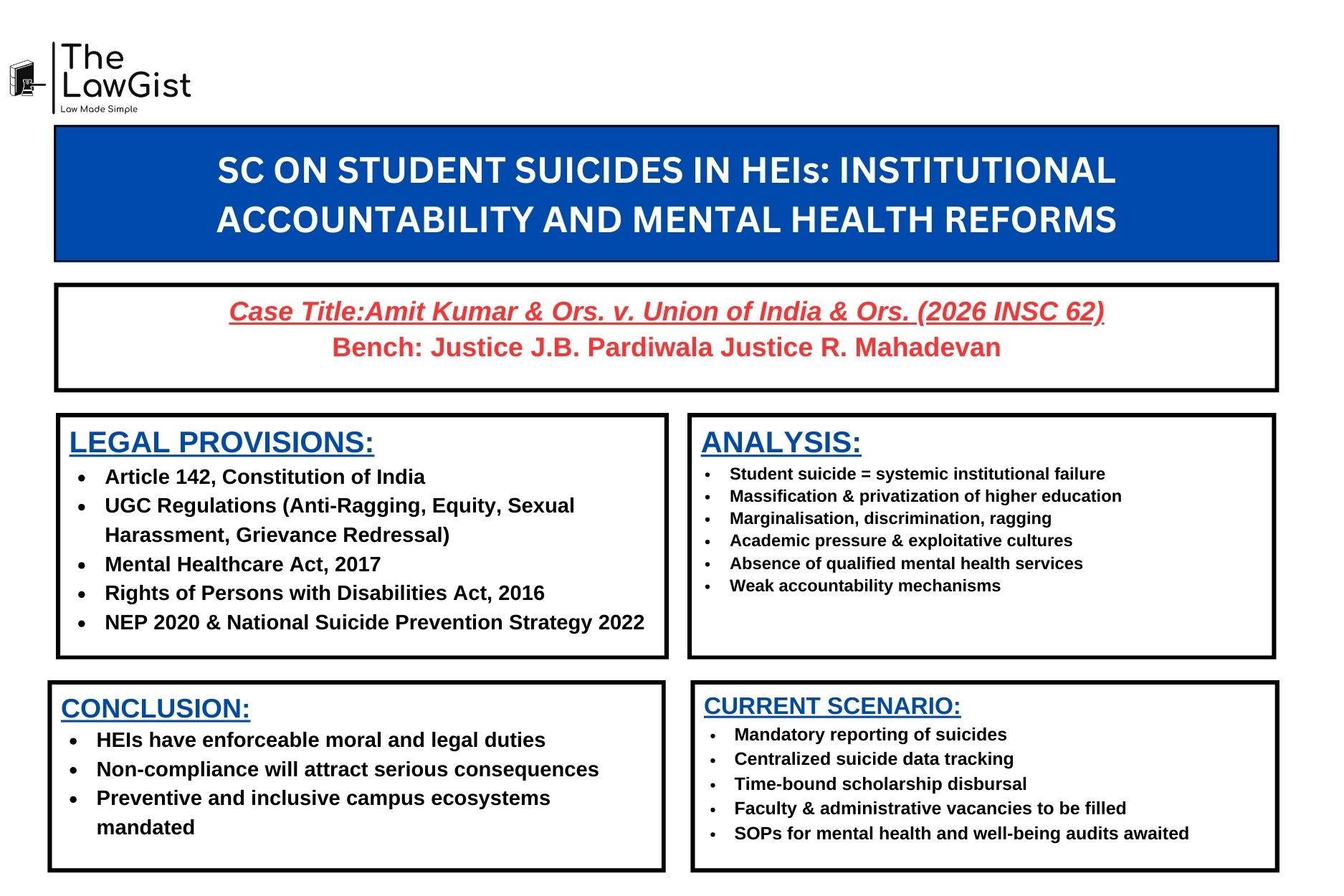
Supreme Court mandates systemic reforms to prevent student suicides in higher educational institutions.
SUPREME COURT ON STUDENT SUICIDES IN HEIs: INSTITUTIONAL ACCOUNTABILITY AND MENTAL HEALTH REFORMS
CASE SUMMARY – The Supreme Court in Amit Kumar vs. Union of India (2026) addressed the escalating crisis of student suicides in Higher Educational Institutions. Recognising suicides as symptoms of systemic failures, the Court constituted a National Task Force to examine underlying causes such as academic pressure, discrimination, financial stress, ragging, and lack of mental health support. Exercising powers under Article 142, the Court issued binding directions mandating suicide reporting, FIR registration, scholarship disbursal, faculty recruitment, and compliance with UGC regulations. The judgment firmly establishes institutional accountability for student mental well-being and calls for comprehensive preventive frameworks across Indian campuses.
| ASPECTS | DETAILS |
| Case Title | Amit Kumar & Ors. vs. Union of India & Ors. |
| Introduction | The Supreme Court addressed the alarming rise in student suicides in Higher Educational Institutions (HEIs) and clarified institutional responsibility, mandatory FIR registration, and preventive mental health mechanisms. |
| Factual Background | The Court noted repeated incidents of student suicides across Indian HEIs. Earlier directions on mandatory FIR registration led the Court to constitute a National Task Force (NTF) to examine systemic causes, legal gaps, and preventive frameworks. |
| Legal Issues |
|
| Applicable Law |
|
| Analysis | The Court recognized student suicides as a systemic failure rather than isolated personal acts. It highlighted structural inequalities, academic pressure, ragging, financial stress, lack of mental health professionals, and weak grievance redressal as key contributors. |
| Conclusion | HEIs cannot evade responsibility by attributing suicides solely to personal autonomy. A duty of care exists, requiring preventive, remedial, and institutional reforms. |
| Current Scenario | Binding nationwide directions issued for reporting suicides, filling vacancies, clearing scholarship backlogs, strengthening grievance bodies, and creating standardized mental health and well-being frameworks in HEIs. |
SOURCE – SUPREME COURT OF INDIA
READ ALSO – SUPREME COURT ON BAIL JURISDICTION AND AGE DETERMINATION UNDER POCSO ACT