Supreme Court forwards the Buddhist community’s plea for separate personal laws to the Law Commission of India for a holistic and structured review.
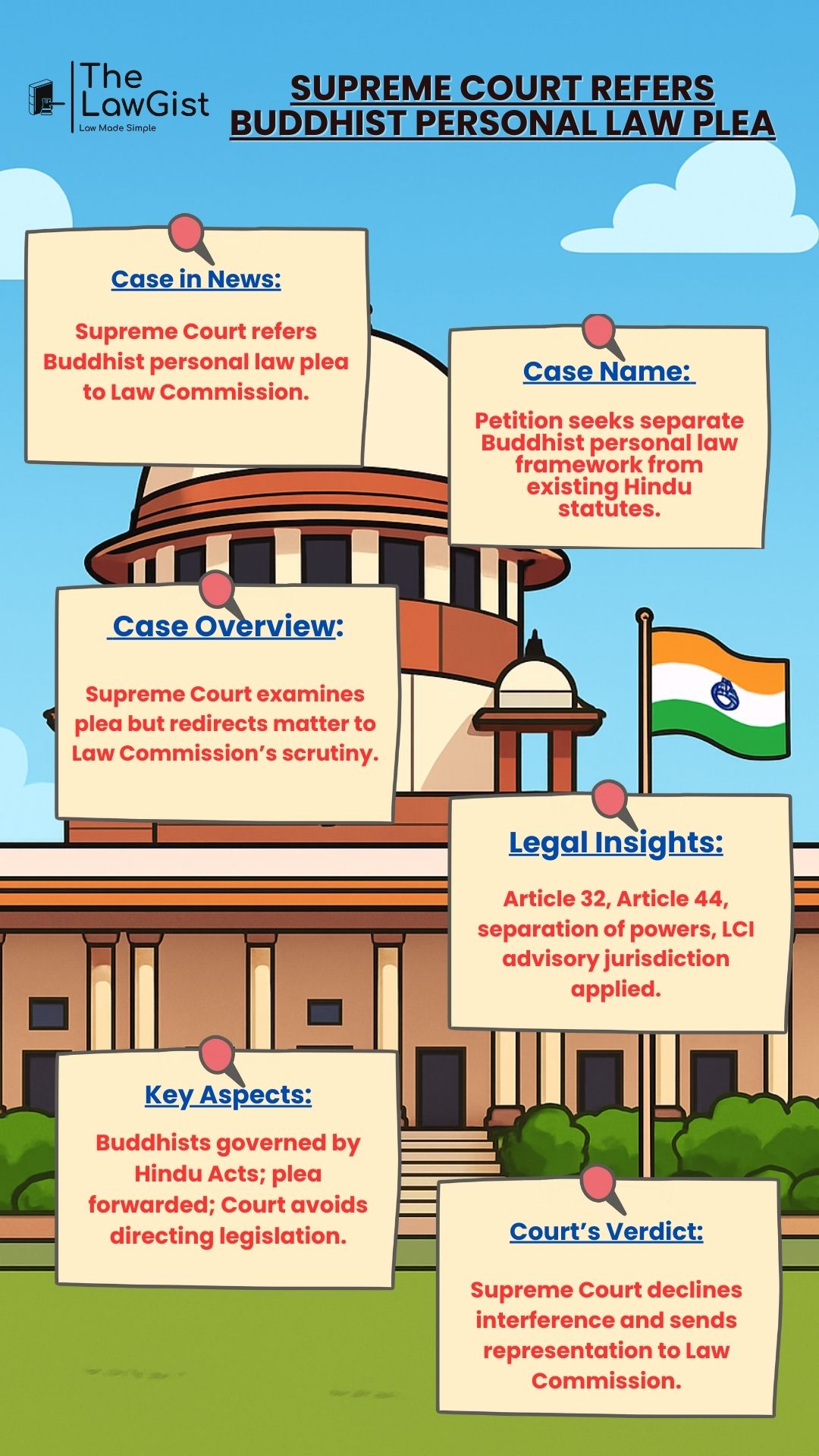
Case in NewsSupreme Court refers Buddhist personal law plea to Law Commission for detailed examination and inputs . |
Discover powerful Latin Maxims and simplify complex legal terms in seconds.
Case Overview
Case Name: Buddhist Personal Law Action Committee vs Union of India & Ors., W.P.(C) 1138/2025
The Supreme Court has referred a plea seeking a separate personal law framework for the Buddhist community to the Law Commission of India . A Bench led by CJI Surya Kant and Justice Joymalya Baghchi heard the petition filed by the Buddhist Personal Law Action Committee . The petitioner argued that Buddhists, despite being a distinct religious community, continue to be governed under Hindu personal laws including the Hindu Marriage Act, 1955 and the Hindu Succession Act, 1956 . The Court clarified that it cannot direct constitutional amendments but can facilitate consultation with the Law Commission .
Step into the world of justice with Courtroom Chronicles
Key Aspects
Before analysing the legal dimensions, it is essential to understand the petition’s concerns . The plea raises questions of identity, religious autonomy, and legislative competence . These factual considerations shaped the Court’s limited intervention :
- Petition sought distinct personal laws exclusively for Buddhists .
- Highlighted that Buddhists are presently governed under Hindu personal law statutes .
- CJI noted Court cannot compel Parliament to amend laws .
- Earlier 21st Law Commission report already examined UCC and related issues .
- Court forwarded the plea as a representation to the Law Commission .
Legal Insights
Understanding the applicable constitutional principles is central to the Court’s approach . The Supreme Court relied on established limits of judicial power and law-making authority :
- Article 32 of Constitution of India – scope of writ jurisdiction in PILs .
- Separation of Powers Doctrine – judiciary cannot direct law-making .
- Article 44 – reference to Uniform Civil Code deliberations .
- Law Commission’s advisory role under its statutory mandate .
Court’s Verdict
The Supreme Court declined to interfere and instead treated the petition as a representation to the Law Commission of India . It directed that the entire paperbook be sent to the Commission and requested the LCI to grant an audience to the petitioner for holistic consideration .
Source – Supreme Court of India
Read also –– Constitution of India
The LawGist ensures exam success with quality notes—TPL, Current Affairs, Recent Judgments, and more. Backed by trusted resources and videos, The LawGist is every aspirant’s first choice.