Madras High Court ruling on Vijay income tax penalty clarifies limitation under Sections 271AAB and 275 of Income Tax Act.
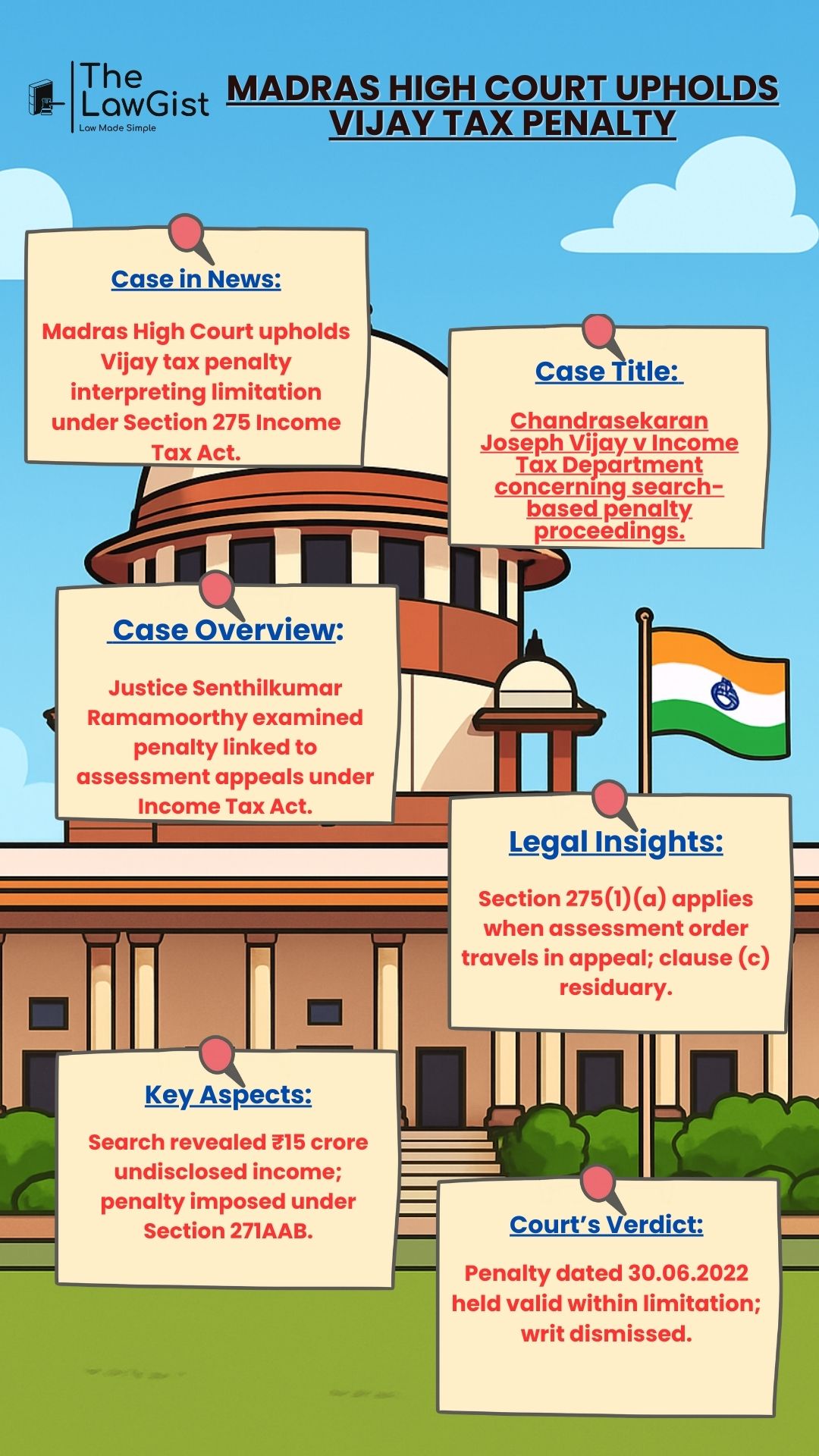
Case in NewsMadras High Court upholds Vijay tax penalty ruling clarifies income tax limitation under search penalty provisions. |
Discover powerful Latin Maxims and simplify complex legal terms in seconds.
Case Overview
Case Name: Joseph Vijay v. Income Tax Department
The Madras High Court income tax dispute arose from a writ petition filed by actor-politician Vijay founder of Tamilaga Vettri Kazhagam & popularly known as Jana Nayagan. Justice Senthilkumar Ramamoorthy examined whether a ₹1.5 crore penalty imposed after a 2015 search was barred by limitation. The penalty related to undisclosed cash income admitted during search proceedings for Assessment Year 2016–17 . Vijay restricted his challenge solely to the issue of limitation under the Income-tax Act, 1961.
Step into the world of justice with Courtroom Chronicles
Key Aspects
The case involved interpretation of statutory timelines for passing penalty orders following search based assessments. The Court focused on whether penalty proceedings were independent or linked to appellate assessment proceedings.
- Search conducted on 30 September 2015 revealed ₹15 crore undisclosed cash income.
- Penalty imposed at 10% under Section 271AAB amounting to ₹1.5 crore .
- The dispute centred on “Rasigar Mandram” fan club expenses of ₹2.92 crore .
- Vijay argued the penalty order dated 30 June 2022 was time barred .
- The department claimed extended limitations due to pending appeals .
Legal Insights
The judgment clarifies the hierarchy of limitation provisions under the Income-tax Act. It distinguishes between residuary & appeal-linked limitation clauses.
- Section 271AAB governs penalties arising from search cases .
- Section 275(1)(a) applies when assessment orders are carried in appeal .
- Section 275(1)(c) is a residuary clause for independent penalty cases.
- Penalty limitation runs from receipt of appellate order, not initiation .
- Parliamentary intent favours specific clauses over residuary provisions .
Court’s Verdict
The Court held that the penalty order was passed within limitation under Section 275(1)(a). Finding no infirmity the Madras High Court income tax bench dismissed Vijay’s petition leaving other grounds open for appellate challenge under law applicable in the State of Tamil Nadu.
Source – Madras High Court
Read also – appeal
The LawGist ensures exam success with quality notes—TPL, Current Affairs, Recent Judgments, and more. Backed by trusted resources and videos, The LawGist is every aspirant’s first choice.