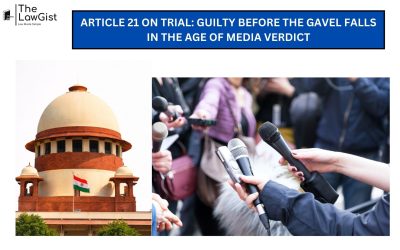
A thought-provoking depiction of the legal and ethical debate on banning convicted politicians for life, reflecting the Supreme Court’s hearing and the Center’s opposition.
OVERVIEW
The Supreme Court of India is currently considering a case that would put a lifetime ban on convicted politicians from running for office, reigniting the debate over criminality in politics. Advocate Ashwini Kumar Upadhyay submitted the plea in 2016, arguing that politicians convicted of crimes should be barred from holding public office for the rest of their lives, similar to government employees who are fired after being found guilty.
However, the Center argued in this regard of a lifetime ban on convicted politicians, claiming that a permanent ban would be unwarranted and unjust and that penalties under penal laws are limited. The issue brings up important issues regarding electoral integrity, legal justice, political ethics, and democratic representation.
CASE: ASHWINI KUMAR UPADHYAY vs. UNION OF INDIA (W.P.(C) No. 699/2016)
The petition seeks to challenge Sections 8 and 9 of the Representation of the People Act, 1951, which regulate disqualification periods for convicted politicians:
- Section 8(1), (2), and (3): A person convicted of specific serious offenses is disqualified for the period of their sentence and six additional years after release.
- Section 9 deals with the public servants dismissed over corruption from holding office for 5 years.
Since the criminal cases over politicians not only erode the public trust but also compromise governance, the petitioner demanded the Apex Court to disqualify such politicians and extend it to the lifetime band.
| Supreme Court’s Concerns | Centre’s Opposition |
| Ethical concerns: Making convicted politicians as lawmakers raise ethical questions regarding public trust over the government. | Judicial overreach: Parliament has authority to make or amend laws regarding disqualification; the judiciary can ask them to make stricter laws. |
| Conflict of interest: To safeguard the laws and policies from getting misused by the convicted individual, it is necessary to take strict action against them. | Existing deterrent: A six-year disqualification after the sentence is already a strong penalty. |
| Precedents: In Public Interest Foundation v. Union of India (2018), the Court stressed the need for decriminalizing politics. | Time-bound punishment: Criminal penalties should not be extended indefinitely beyond the prescribed legal framework. |
| Fairness in democracy: The public servant faces disqualification permanently over corruption; why should politicians receive preferential treatment? | Proportionality: A lifetime ban would be excessive and unfair, depriving individuals of their right to contest elections after serving their sentence. |
| Public interest: A cleaner political system strengthens democracy and public confidence in governance. | Fundamental rights: A blanket lifetime ban may violate the right to equality (Article 14) and the right to participate in democratic processes. |
CRIMINALIZATION IN POLITICS

Criminalization of politics remains a concern—the ADR report reveals 42% of MPs have pending cases, with serious offenses like corruption and murder, highlighting delays in justice and threats to democracy.
Despite various reforms, the criminalization of politics remains a major concern.
- As per the ADR report, 42% of sitting Lok Sabha MPs have pending criminal cases.
- 5% of MPs are billionaires, raising concerns over money power influencing democracy.
- Over 5,000 criminal cases against MPs and MLAs remain pending for decades.
- Cases related to serious offenses such as murder, corruption, and sexual assault continue to linger in courts.
Amicus Curiae Vijay Hansaria, in his report, termed this a “matter of national shame,” emphasizing the failure to expedite cases against lawmakers.
PERSPECTIVES ON THE ISSUE
1. LEGAL PERSPECTIVE
- The principle of proportionality ensures punishments are neither excessive nor arbitrary.
- Various penal laws limit the period of punishment, ensuring the convicted individual is given a second chance.
- Lifetime disqualification would violate Article 14 (Right to Equality) if similar restrictions do not apply to other professionals.
2. POLITICAL PERSPECTIVE
- Conflict of interest arises when convicted politicians influence laws.
- Due to financial benefits and vote-bank tactics, political parties still make candidates with criminal histories contest elections.
- The Election Commission of India (ECI) has pushed for stricter laws, but Parliament has not implemented stronger disqualification criteria.
3. ETHICAL PERSPECTIVE
- Public trust in democracy is weakened when convicted politicians return to power.
- A lifetime ban could help clean up the system, sending a strong message against criminal behavior in politics.
- However, redemption and rehabilitation are also fundamental aspects of justice.
WAY FORWARD
Although Judiciary itself can not enact laws in this regard, Judiciary can recommend stricter laws to Parliament-
- Extending disqualification for 10-15 years instead of a lifetime ban.
- Fast-tracking criminal cases against lawmakers within a fixed time frame.
- Enhancing the transparency of elections by making political parties provide justification for running candidates with criminal histories.
- Barring persistent criminals from abusing democracy by prohibiting them from running for office.
CONCLUSION
The Supreme Court’s decision in this case plays an important role in this matter, as it goes right to the heart of India’s democratic principles.A lifetime ban can be unjust and unreasonable in some cases, but it would guarantee cleaner politics. To maintain a balance in the political system, it is required to respect the democratic principles and not make misuse of them by finding loopholes in the system, and it also needs to discourage criminal activity. However, it is the responsibility of the legislators to make sure that illegal influences do not corrupt democracy.
ENDNOTES
- Sections 8 & 9 of RP (Representation of the People Act), 1951
- Public Interest Foundation v. Union of India (2018) 5 SCC 400
- ADR Report, 2024: Criminal Cases Against MPs & MLAs (PDF)
- Supreme Court Observations, February 2025 Hearing
Also Read: DIGITAL ARREST SCAM