
Hindu law
Hindu law is a body of laws based on ancient scriptures, customs, and court decisions that apply to Hindus, who are followers of the predominant religious and social system in India. It includes religious duties, civil and criminal law, family law, marriage and succession rights, as well as the rights of women and children. Hindu law is based on the principles of dharma, which is a combination of religious, moral, and ethical codes that govern a person’s daily life. The law is derived from the ancient Vedic texts of Hinduism, as well as from the commentaries of ancient Hindu lawgivers. It is supplemented by modern legislation.
Recent Posts
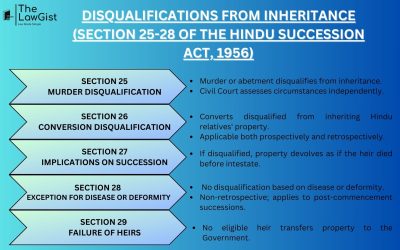
DISQUALIFICATIONS FROM INHERITANCE (SECTION 25-28 OF THE HSA, 1956)
Introduction In the realm of inheritance law in India, the Hindu Succession Act, 1956 plays a pivotal role in defining the rights and disqualifications of individuals seeking to inherit property. Sections 25 to 28 of Hindu Succession Act,1956 outline specific grounds...

PREFERENTIAL RIGHT TO ACQUIRE PROPERTY IN CERTAIN CASES ( SECTION 22 OF THE HSA )
INTRODUCTION The Hindu Succession Act, 1956, governs the inheritance of property among Hindus. Section 22 of this Act introduces the concept of "Preferential Right," which is often confused with the “Right of Pre-emption.” This discussion aims to clarify the...

GENERAL RULES OF SUCCESSION IN THE CASE OF FEMALE HINDUS(SECTION 15 OF HSA,1956)
INTRODUCTION In the Hindu Succession Act of 1956, rules governing female succession are delineated in Section 15 and Section 16. Understanding the origin of the property is crucial for determining the applicable provisions for succession. SECTION 15 OF HINDU...

PROPERTY OF A FEMALE HINDU TO BE HER ABSOLUTE PROPERTY (SECTION 14 OF HSA,1956)
INTRODUCTION The Hindu Succession Act of 1956 marks a pivotal moment in the evolution of property rights for females in India. This comprehensive legislation aimed to eradicate historical disparities and empower women by granting them absolute ownership of property....
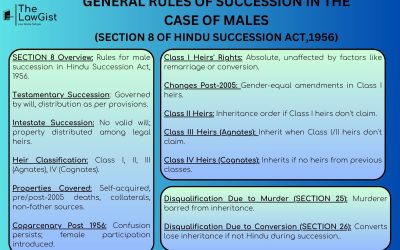
GENERAL RULES OF SUCCESSION IN THE CASE OF MALES(SECTION 8 OF HSA,1956)
INTRODUCTION Section 8 of the Hindu Succession Act,1956 delineates the "General Rules of Succession in the Case of Males." These rules apply to various types of properties owned by Hindu males, covering aspects such as self-acquired property, succession from separated...

DEVOLUTION OF INTEREST IN COPARCENARY PROPERTY (SECTION 6 OF HSA, 1956)
INTRODUCTION The Hindu Succession Act, 1956, stands as a landmark legislation addressing property inheritance among Hindus, with a particular focus on intestate or unwilled properties. This discussion delves into the Act's historical context, significant amendments,...