Dadri lynching case highlights judicial control over Section 321 CrPC and limits on executive withdrawal of prosecution in serious criminal offences.
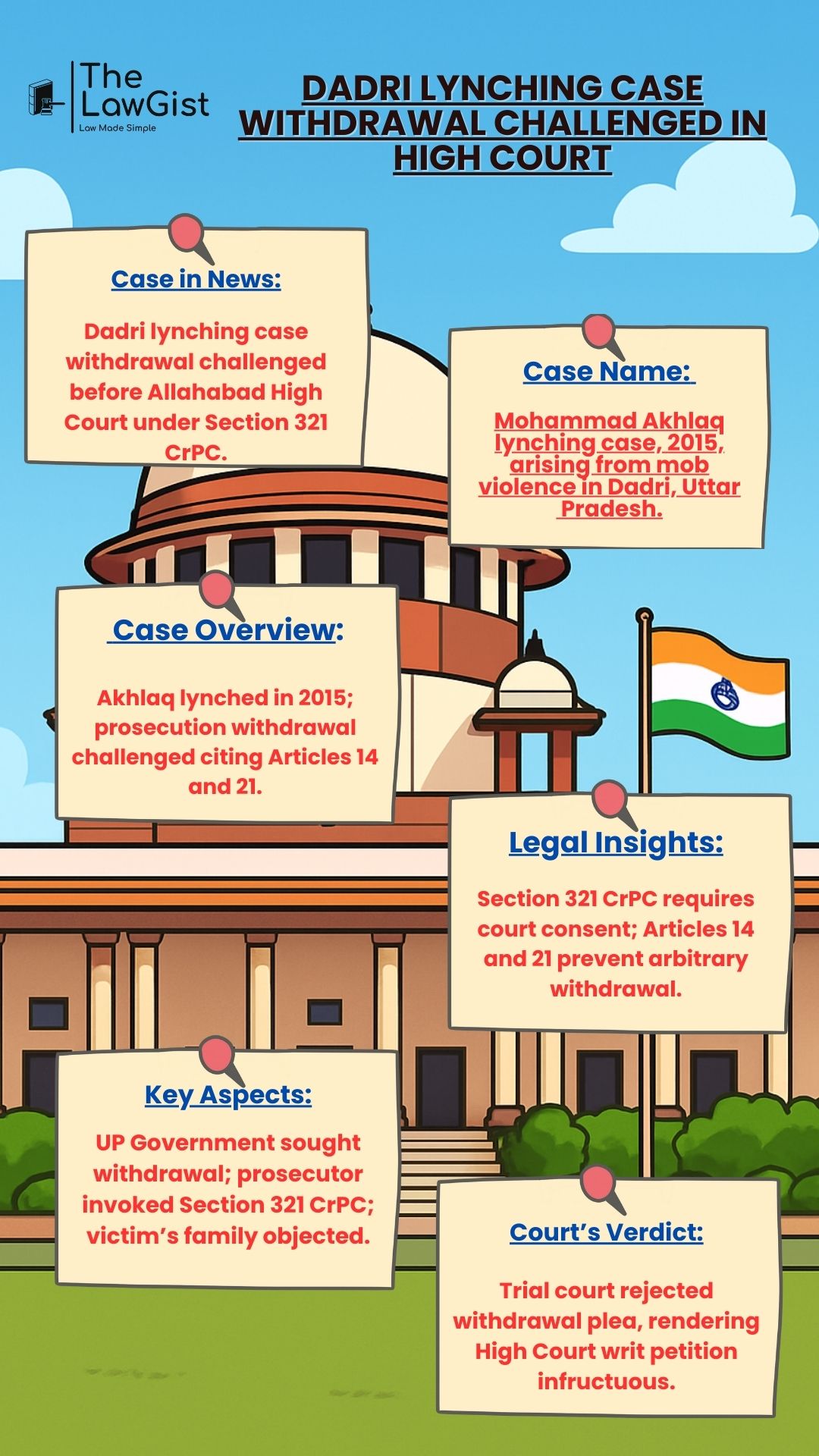
Case in NewsDadri lynching case withdrawal challenged in High Court after UP Government sought to drop prosecution . |
Discover powerful Latin Maxims and simplify complex legal terms in seconds.
Case Overview
Case Name: Mohammad Akhlaq Lynching Case, 2015 (Dadri)
The Dadri–Mohammad Akhlaq lynching case stems from a 2015 incident in Dadri, Gautam Budh Nagar, Uttar Pradesh, where Mohammad Akhlaq was lynched by a mob over allegations of storing and consuming beef . An FIR was registered under multiple IPC provisions including murder . Eighteen accused were named including three juveniles; one accused later died, while the remaining accused are on bail. In 2025, the Uttar Pradesh Government initiated steps for Withdrawal From Prosecution, prompting strong resistance from the victim’s family . Akhlaq’s wife approached the Allahabad High Court challenging the executive and prosecutorial actions facilitating withdrawal .
Step into the world of justice with Courtroom Chronicles
Key Aspects
The controversy primarily revolves around the State’s attempt to withdraw prosecution in a serious offence involving mob violence and loss of life . The facts and issues highlight the tension between executive discretion and judicial oversight in criminal justice administration .
- Mob lynching of Mohammad Akhlaq in 2015 following communal allegations .
- FIR registered under IPC offences, including Section 302 (murder) .
- UP Government moved an application seeking withdrawal of the case .
- Prosecutor filed an application before the trial court under Section 321 CrPC .
- Victim’s family objected, alleging miscarriage of justice .
Legal Insights
The legal debate focuses on prosecutorial independence and constitutional limits on executive power . Courts play a crucial role in ensuring that withdrawals are not arbitrary or politically motivated .
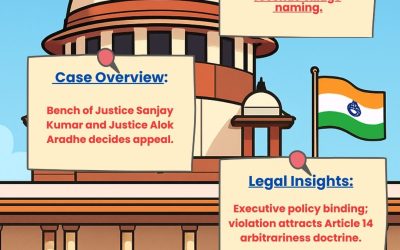
- Section 321 CrPC: Withdrawal from prosecution requires court’s consent .
- Prosecutor must apply independent mind, not merely follow executive instructions .
- Article 14, Constitution of India: Protection against arbitrary state action .
- Article 21, Constitution of India: Right to life and fair procedure .
Court’s Verdict
The trial court in Gautam Budh Nagar rejected the Uttar Pradesh Government’s application seeking withdrawal of prosecution . As a result, the writ petition filed by Akhlaq’s wife before the Allahabad High Court has been rendered infructuous . The decision reinforces judicial scrutiny over executive attempts to dilute prosecutions in grave offences like the Dadri lynching .
Source – Allahabad High Court
Read also –Constitution of India
The LawGist ensures exam success with quality notes—TPL, Current Affairs, Recent Judgments, and more. Backed by trusted resources and videos, The LawGist is every aspirant’s first choice.