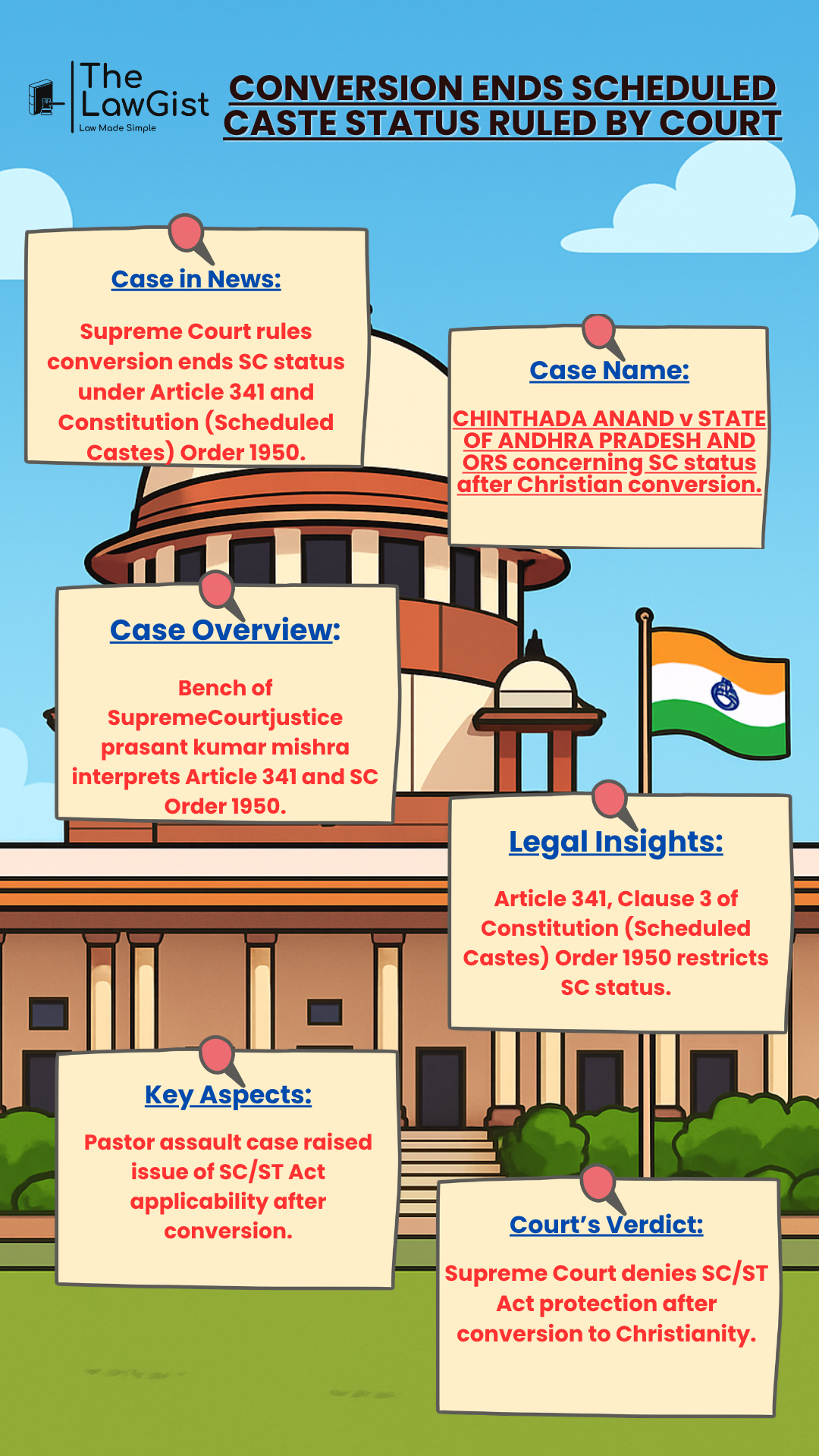
Supreme Court clarifies that conversion to Christianity results in immediate loss of Scheduled Caste status under Article 341 and the Constitution (Scheduled Castes) Order, 1950.
Case in News
Conversion Ends Scheduled Caste Status Ruled By Court highlighted in Supreme Court of India pastor dispute over SC status claim.
Discover powerful Latin Maxims and simplify complex legal terms in seconds
Case Name
Chinthada Anand v State Of Andhra Pradesh And Ors
Case Overview
The Supreme Court of India delivered an important ruling in Chinthada Anand v State Of Andhra Pradesh And Ors clarifying the legal consequences of religious conversion on Scheduled Caste status. The bench comprising Supreme court justice Prasant kumar mishra & Justice Manmohan examined whether a person who converted to Christianity could claim protection under the Scheduled Castes & Scheduled Tribes (Prevention of Atrocities) Act.
The case arose after a pastor alleged assault & caste-based abuse during a prayer meeting & filed a complaint invoking provisions of the SC/ST Act. The accused challenged the complaint arguing that the complainant had converted to Christianity & thus could not legally claim Scheduled Caste status under the Constitution (Scheduled Castes) Order, 1950.
Key Aspects
This case raised crucial constitutional & statutory questions regarding the intersection of religion & caste-based protections. The Court examined whether a person who converts to another religion can still claim Scheduled Caste benefits granted under Indian law. The factual circumstances surrounding the alleged assault & the complainant’s religious identity became central to the dispute.
- The complainant originally belonged to the Madiga Scheduled Caste but had converted to Christianity.
- He functioned as a pastor & regularly conducted Sunday prayer meetings in the village.
- He alleged assault, threats & caste-based abuse during one such prayer gathering.
- An FIR was registered under the Scheduled Castes & Scheduled Tribes (Prevention of Atrocities) Act & IPC provisions.
- The accused sought quashing of charges arguing that conversion resulted in loss of Scheduled Caste status.
Legal Insights
The Court analyzed the constitutional scheme governing recognition of Scheduled Castes & the statutory structure regulating caste-based protections. It clarified how religion affects eligibility for such constitutional benefits. The judgment reaffirmed that statutory protections linked to Scheduled Caste identity must strictly comply with constitutional provisions.
Article 341 of the Constitution: Empowers the President to specify Scheduled Castes through a Presidential Order for different states.
Constitution (Scheduled Castes) Order, 1950 – Clause 3
- Provides that persons professing religions other than Hinduism, Sikhism or Buddhism cannot be treated as Scheduled Castes.
- Conversion to any other religion results in immediate loss of SC status.
Scheduled Castes & Scheduled Tribes (Prevention of Atrocities) Act :Protection under the Act is available only to legally recognized members of Scheduled Castes or Scheduled Tribes.
Court’s Verdict
The Supreme Court of India upheld the Andhra Pradesh High Court’s decision & ruled that the complainant who continued to practice Christianity and function as a pastor, could not claim Scheduled Caste status. As a result he was not entitled to invoke protections under the Scheduled Castes & Scheduled Tribes (Prevention of Atrocities) Act reaffirming the absolute bar under Clause 3 of the Constitution (Scheduled Castes) Order, 1950.
The LawGist ensures exam success with quality notes—TPL, Current Affairs, Recent Judgments, and more. Backed by trusted resources and videos, The LawGist is every aspirant’s first choice
Read also-Constitution
Source-Supreme Court of India