Case in NewsBritish geopolitics behind creation of Pakistan debated at British geopolitics behind creation of Pakistan book launch . |
Discover powerful Latin Maxims and simplify complex legal terms in seconds.
Overview
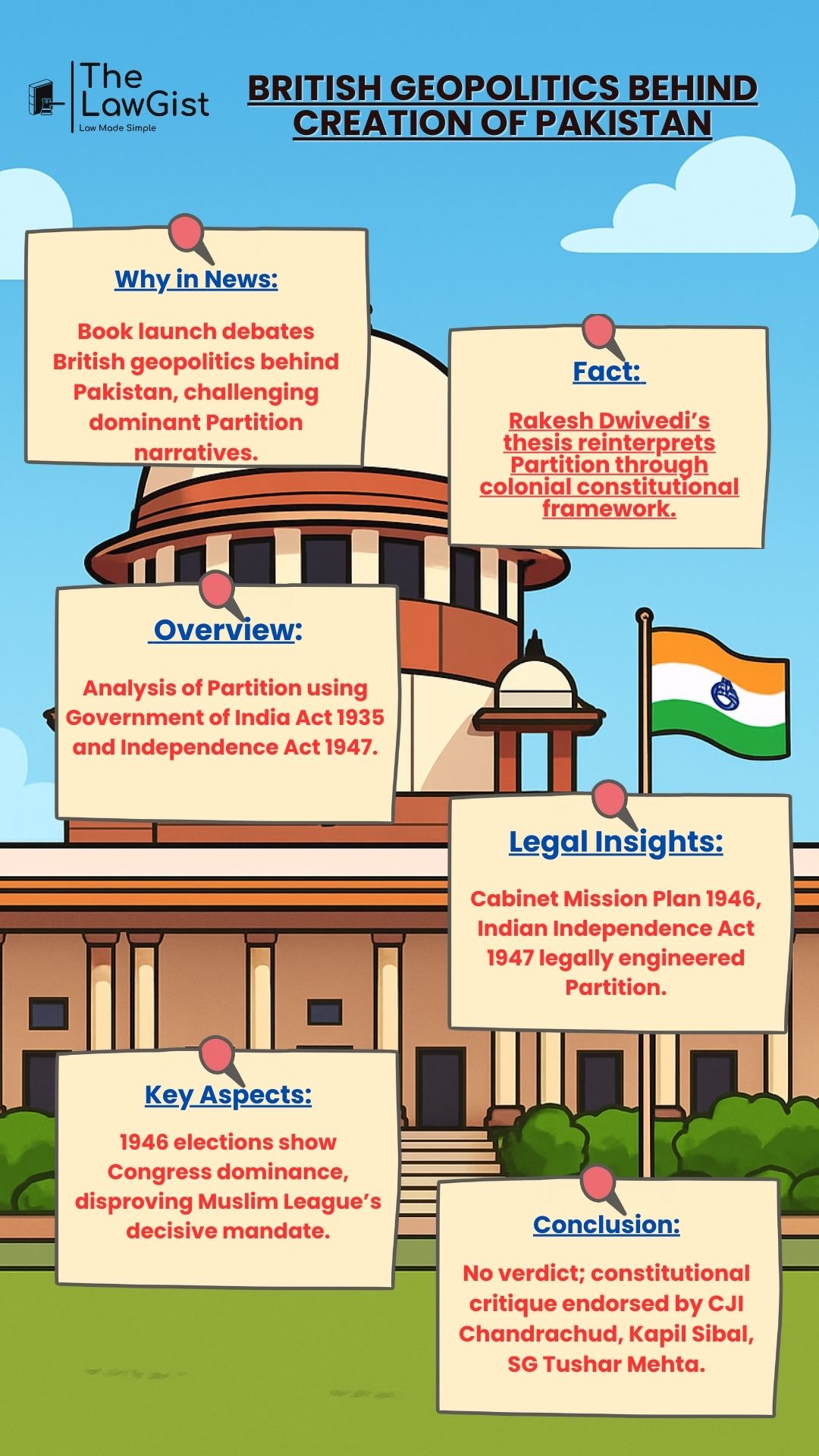
The issue emerged from a Book Launch of Colonization Crusade & Freedom of India authored by Rakesh Dwivedi. The book was released by CJI Chandrachud at the India International Centre, New Delhi in the presence of Kapil Sibal and SG Tushar Mehta. Dwivedi questioned the dominant historical narrative that credits Mohammad Ali Jinnah with creating Pakistan arguing instead that British geopolitical strategy during the transfer of power was decisive.
Step into the world of justice with Courtroom Chronicles
Key Aspects
The discussion revisits the political, electoral & administrative realities preceding Partition. It seeks to shift focus from individual leadership to imperial decision-making supported by archival evidence & electoral data from the final years of British Colonial Rule .
- Transfer of power documents indicated British orchestration of Partition .
- 1946 provincial elections showed Congress governments in most provinces .
- Muslim League lacked all-India dominance to independently form Pakistan .
- Coalition governments existed even in Muslim-majority provinces .
- Partition violence linked to hurried imperial withdrawal strategies.
Legal Insights
From a constitutional standpoint the book analyses how colonial legal frameworks enabled Partition. It treats decolonisation as a legally engineered process rather than a purely political inevitability grounded in statutory instruments of British India.
- Government of India Act, 1935 enabled provincial autonomy but retained imperial control .
- Cabinet Mission Plan, 1946 proposed federal unity before being diluted .
- Indian Independence Act, 1947 legally sanctioned Partition and dominion status.
- British Crown’s residual powers shaped boundary & sovereignty decisions.
- Post-colonial constitutional interpretation challenges colonial legality narratives.
Conclusion
No judicial verdict was involved. However CJI Chandrachud observed that empire legitimised conquest through repetition while Kapil Sibal asserted that British policy not Mohammad Ali Jinnah was central to Pakistan’s creation. SG Tushar Mehta described the work as dismantling the moral justifications of the empire .
Source – Supreme Court of India
The LawGist ensures exam success with quality notes—TPL, Current Affairs, Recent Judgments, and more. Backed by trusted resources and videos, The LawGist is every aspirant’s first choice.