
Bharatiya Sakshya Adhiniyam (Evidence Law)
The Indian Evidence Law has been superseded by the Bharatiya Sakshya Adhiniyam, marking a significant evolution in the regulation of evidence presentation in Indian courts. Enacted on December 25, 2023, the Bharatiya Sakshya Adhiniyam meticulously governs the admissibility, examination, and cross-examination of evidence, ensuring fairness and impartiality in legal proceedings. This replacement aims to uphold the integrity of the justice system by admitting only relevant and reliable evidence for consideration during trials. Like its predecessor, the Indian Evidence Act of 1872, the new law divides evidence into various types and establishes rules for its presentation. With its comprehensive provisions, including those concerning relevancy, presumption, burden of proof, and admissibility, the Bharatiya Sakshya Adhiniyam stands as a cornerstone of fair and equitable adjudication. Enforced from July 1, 2024, it reflects India’s commitment to modernizing legal frameworks to meet the evolving needs of its justice system while ensuring the protection of citizens’ rights.
Recent Posts

REFRESHING MEMORY (SECTION 159-160)
INTRODUCTION Witness testimony plays a crucial role in legal proceedings, and to be an effective witness, one must accurately recall and communicate facts. Sections 159 and 160 of the Indian Evidence Act address the concept of Refreshing a Witness's Memory to ensure...

IMPEACHING CREDIT OF WITNESS (SECTION 155)
DEFINITION OF IMPEACHING CREDIT Impeaching The Credit Of A Witness under Indian Evidence Act,involves revealing their true character before the court, leading to a loss of trust in their testimony. This can be initiated by the opposite party or, with court...

EXAMINATION OF WITNESSES (SECTION 137-138)
EXAMINATION-IN-CHIEF Definition : Section 137 designates the witness examination by the party who calls them as "Examination-In-Chief," with Section 138 emphasizing its priority. Objective : The primary goal of Examination-In-Chief is to extract all material facts...

LEADING QUESTIONS (SECTION 141-143)
SECTION 141: DEFINING LEADING QUESTIONS Section 141 is pivotal in understanding what constitutes a Leading Question under Indian Evidence Act.It states that a question is leading when it suggests the answer that the questioner desires to receive. In essence, Leading...

DOCTRINE OF ESTOPPEL (SECTION 115-117)
The Doctrine of Estoppel in the Indian Evidence Act holds that a person cannot contradict a fact they have previously asserted through words or conduct. This doctrine is guided by the maxim ‘allegans contraria non est audiendus,’ meaning contrary allegations will not...
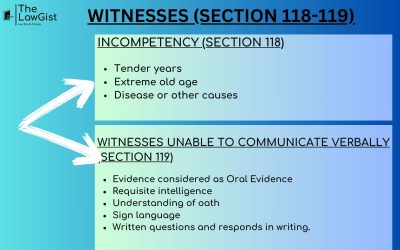
WITNESSES (SECTION 118-119)
COMPETENCY OF WITNESSES (SECTION 118 ) Section 118 of the Indian Evidence Act defines the competency of witnesses in legal proceedings. It establishes that a witness under Indian Evidence Act,is considered competent unless there are legal reasons to prevent them from...