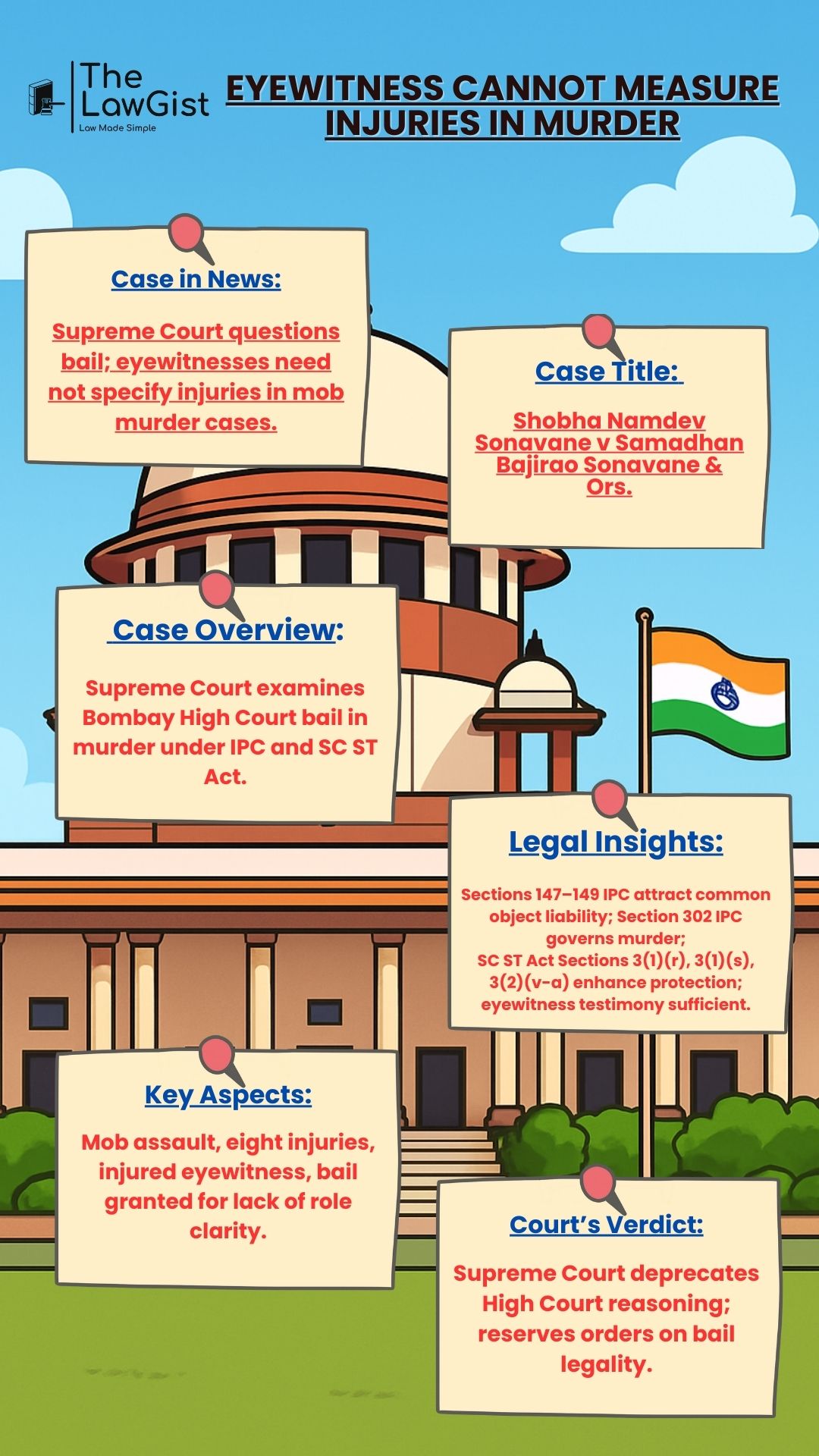
Supreme Court questions Bombay High Court bail, says eyewitnesses cannot measure injuries in mob murder cases.
Case in NewsEyewitness Cannot Measure Injuries In Murder questioned by Supreme Court of India while examining Bombay High Court bail order. |
Discover powerful Latin Maxims and simplify complex legal terms in seconds.
Case Overview
Case Name: Shobha Namdev Sonavane v. Samadhan Bajirao Sonvane & Ors.
The Supreme Court of India comprising Justice Vikram Nath & Justice Sandeep Mehta examined the legality of a Bombay High Court order granting bail to two accused in a murder case involving caste-based violence . The petition was filed by the deceased’s wife challenging the High Court’s reasoning that the FIR lacked specific allegations about which accused inflicted which injury . The matter arises from a 2022 incident where a Scheduled Caste member was allegedly beaten to death over a land dispute . After hearing the parties the Court reserved its judgment.
Step into the world of justice with Courtroom Chronicles
Key Aspects
The case raises serious concerns regarding appreciation of eyewitness evidence at the bail stage particularly in mob violence & atrocity cases. The Supreme Court of India questioned whether such technical reasoning undermines criminal justice.
- Deceased was assaulted by six accused using iron rods & sticks in a public market.
- FIR and statements showed indiscriminate assault causing 8 injuries .
- Bombay High Court granted bail citing absence of specific role attribution .
- Petitioner was herself an injured eyewitness and alleged caste-based abuse.
Legal Insights
The Court emphasized settled principles governing bail, unlawful assembly & atrocity offences. Individual attribution of injuries is not mandatory where collective liability is alleged .
- Sections 147, 148, 149 IPC: Common object makes each member vicariously liable .
- Section 302 IPC(Bharatiya Nyaya Sanhita, 2023) : Gravity of murder must guide bail discretion.
- SC/ST Act, Sections 3(1)(r), 3(1)(s), 3(2)(v-a) : Enhanced protection in caste atrocities.
- Eyewitness Testimony : Credibility not weakened by inability to detail specific injuries.
Court’s Verdict
The Supreme Court of India strongly deprecated the High Court’s approach observing that eyewitnesses are not expected to have “photographic memory” or measure injuries during mob assaults. Justice Sandeep Mehta clarified that recovery & specific role attribution are not decisive at the bail stage when common object applies. The Court reserved orders signalling stricter scrutiny of bail in serious offences under the SC ST Act.
Source – Supreme Court of India
Read also – Bharatiya Nyaya Sanhita, 2023
The LawGist ensures exam success with quality notes—TPL, Current Affairs, Recent Judgments, and more. Backed by trusted resources and videos, The LawGist is every aspirant’s first choice.