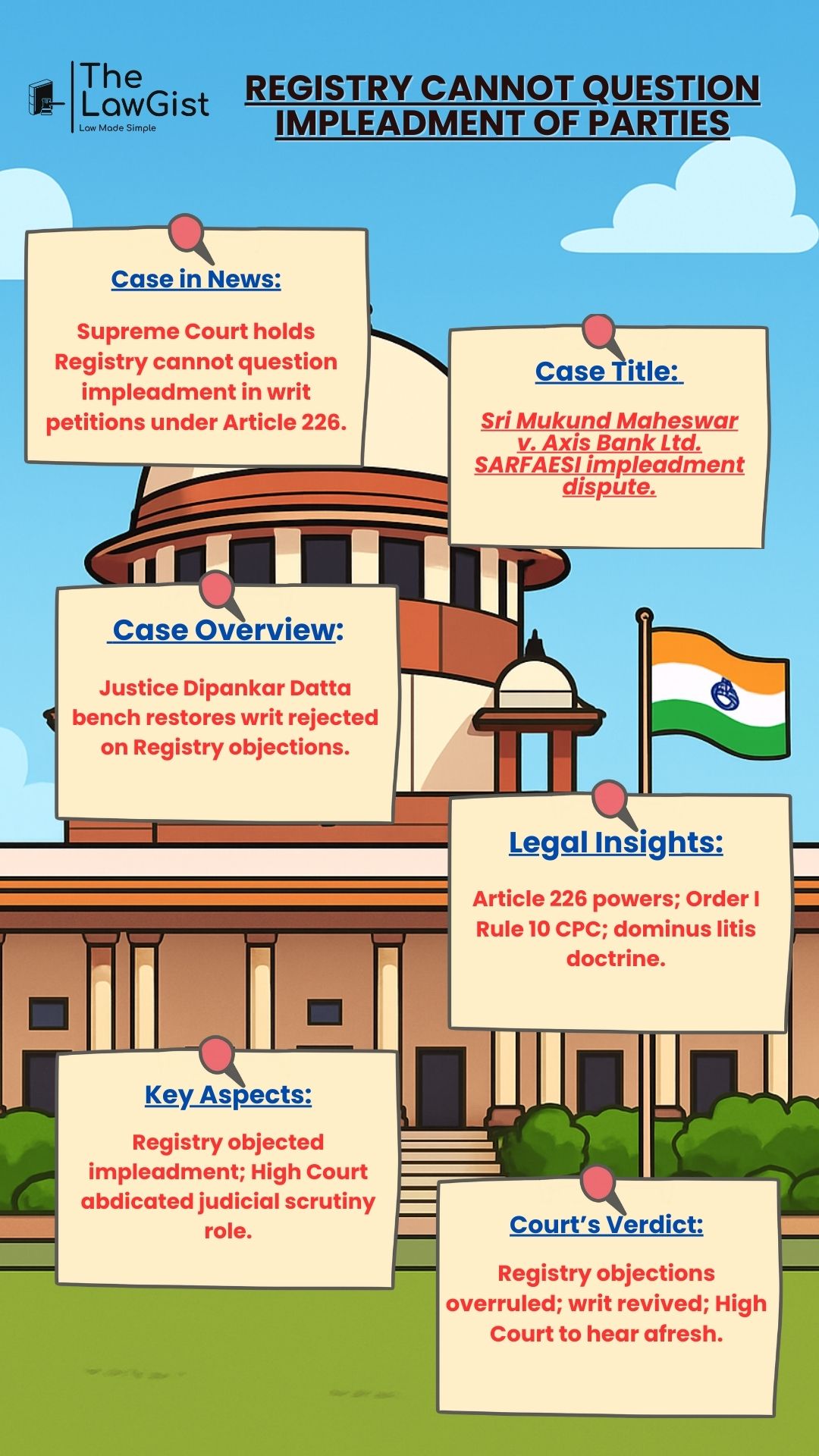
Case in NewsRegistry Cannot Question Impleadment Of Parties, Supreme Court rules Registry cannot intrude into judicial domain . |
Discover powerful Latin Maxims and simplify complex legal terms in seconds.
Case Overview
Case Name: Sri Mukund Maheswar & Anr. vs. Axis Bank Ltd. & Ors.
In Sri Mukund Maheswar & Anr. v. Axis Bank Ltd. & Ors., the Supreme Court examined the extent of powers exercised by court registries in scrutinising writ petitions . A bench comprising Justice Dipankar Datta and Justice Satish Chandra Sharma set aside an order of the Telangana High Court which had accepted objections raised by the Registry regarding impleadment of parties in a writ petition filed under Article 226 of the Constitution in a SARFAESI dispute . The Court firmly reiterated that the Registry cannot interfere in matters falling exclusively within the judicial domain .
Step into the world of justice with Courtroom Chronicles
Key Aspects
The dispute arose from a writ petition alleging fraudulent and collusive conduct by a court-appointed Commissioner during possession proceedings under the SARFAESI Act . Instead of adjudicating the issue judicially, the High Court rejected the petition based on Registry objections . Facts and Issues :
- Writ petition filed under Article 226 challenging SARFAESI proceedings .
- Registry objected to prayer clause and array of parties .
- High Court rejected petition and returned papers .
- Issue whether Registry can question impleadment of parties .
- Scope of dominus litis and judicial discretion.
Legal Insights
The Supreme Court clarified settled procedural principles governing impleadment and judicial review. Relevant Legal Provisions :
- Article 226 of Constitution of India : Power of High Courts to issue writs .
- Order I Rule 10 CPC: Court’s power to add or strike out parties .
- Doctrine of Dominus Litis : Petitioner’s right to choose parties.
- Judicial duty to assess misuse of impleadment not Registry’s role.
Court’s Verdict
Allowing the appeal, the Supreme Court held that the Registry committed a Registry Error by intruding into judicial functions . The writ petition was revived, Registry objections were overruled and the High Court was directed to list the matter before a different Division Bench for adjudication in accordance with law .
Source – Supreme Court of India
Read also – Constitution of India
The LawGist ensures exam success with quality notes—TPL, Current Affairs, Recent Judgments, and more. Backed by trusted resources and videos, The LawGist is every aspirant’s first choice.