Justice Ujjal Bhuyan underscores constitutional morality, judicial review, and the Supreme Court’s role in protecting liberty and democratic governance.
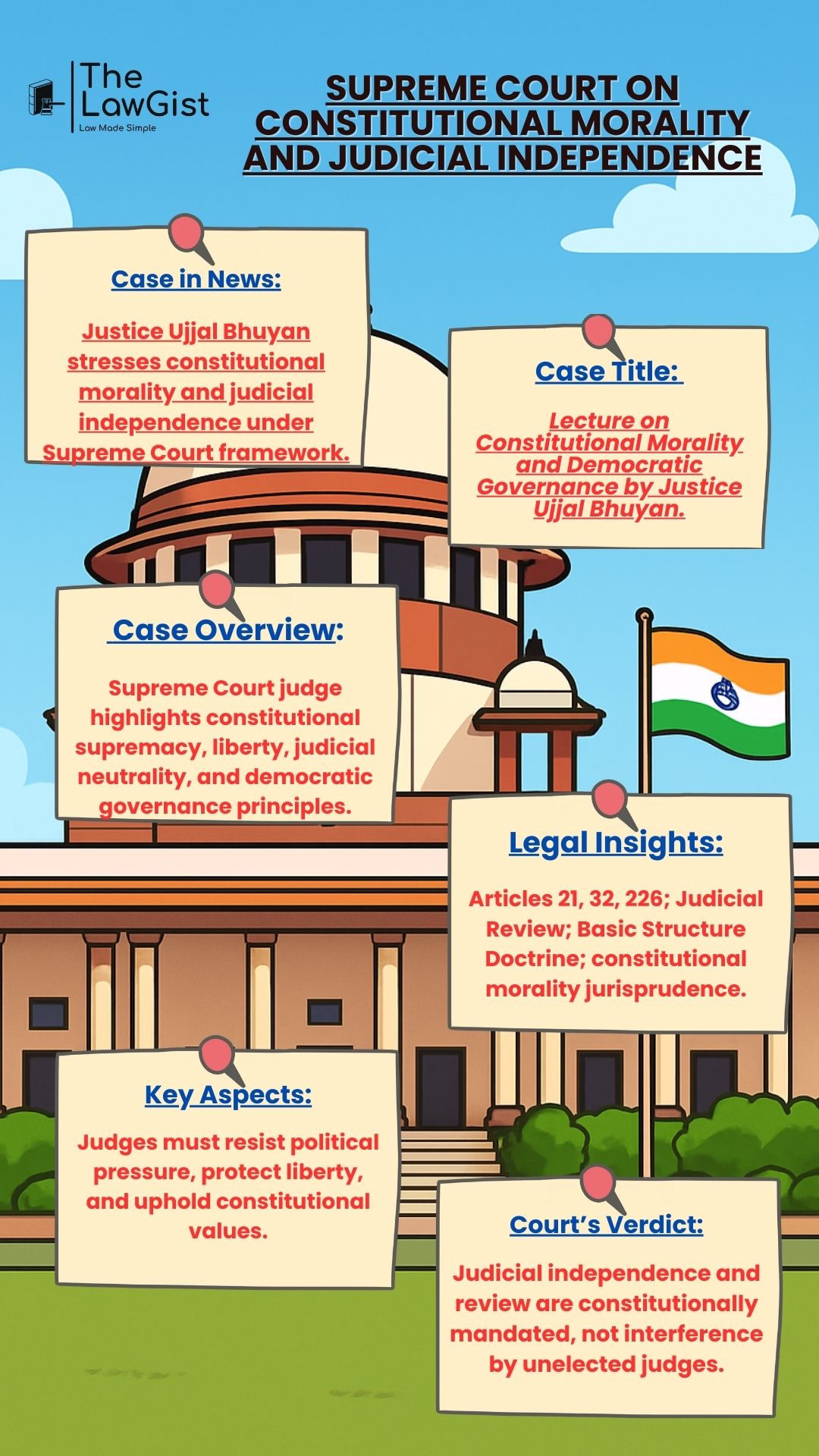
Case in NewsSupreme Court on Constitutional Morality and Judicial Independence stressed by Justice Ujjal Bhuyan during a public lecture . |
Discover powerful Latin Maxims and simplify complex legal terms in seconds.
Fact
Justice Ujjal Bhuyan’s Lecture on Constitutional Morality and Democratic Governance
Overview
A sitting judge of the Supreme Court, Justice Ujjal Bhuyan, delivered a lecture at ILS Law College, Pune, highlighting the indispensable role of constitutional morality and judicial independence in a democracy . He cautioned courts against yielding to political pressures and reiterated that denial of personal liberty and human rights through constitutional distortion undermines democratic governance . Drawing from constitutional history, Justice Bhuyan recalled the vision of the founding fathers, emphasizing that the judiciary must remain neutral, firm, and guided solely by the Constitution .
Step into the world of justice with Courtroom Chronicles
Key Aspects
Justice Bhuyan’s address was not case-specific but addressed broader constitutional concerns affecting democratic institutions . He outlined how judicial conduct, public perception and constitutional fidelity are deeply interconnected in maintaining the rule of law . Facts and Issues Involved:
- Need for judges to stand firm against prevailing political winds .
- Concern over courts being perceived as justifying denial of liberty .
- Debate on judicial review being termed interference by “unelected judges” .
- Assertion of constitutional supremacy over parliamentary sovereignty .
- Role of courts in protecting marginalized voices .
Legal Insights
Justice Bhuyan anchored his views firmly within constitutional provisions and landmark judicial doctrines. He clarified that judicial review and independence are not self-assumed powers but constitutionally conferred duties essential for democratic balance .Relevant Legal Provisions and Principles :
- Article 21 of Constitution of India: Protection of life and personal liberty .
- Articles 32 and 226 : Constitutional basis of judicial review.
- Basic Structure Doctrine (Kesavananda Bharati v. State of Kerala) : Limits on constitutional amendments .
- Constitutional Morality (Indian Young Lawyers Association v. State of Kerala) : Fundamental rights override social morality.
- Rule of Law as an essential feature of the Constitution .
Conclusion
Though delivered outside adjudication, Justice Bhuyan’s remarks reaffirmed that judicial review is central to constitutional governance . He concluded that constitutional morality demands independence, restraint from popular pressures and unwavering protection of fundamental rights principles vital for sustaining democracy .
Source – Supreme Court of India
Read also – Constitution of India
The LawGist ensures exam success with quality notes—TPL, Current Affairs, Recent Judgments, and more. Backed by trusted resources and videos, The LawGist is every aspirant’s first choice.