Major legal and governance developments in skill development, statistics, and international cooperation.
DAILY CURRENT AFFAIRS (16 JANUARY 2026)
CSIR INTEGRATED SKILL INITIATIVE: STRENGTHENING INDIA’S SKILL ECOSYSTEM THROUGH SCIENCE & TECHNOLOGY
Summary of the News
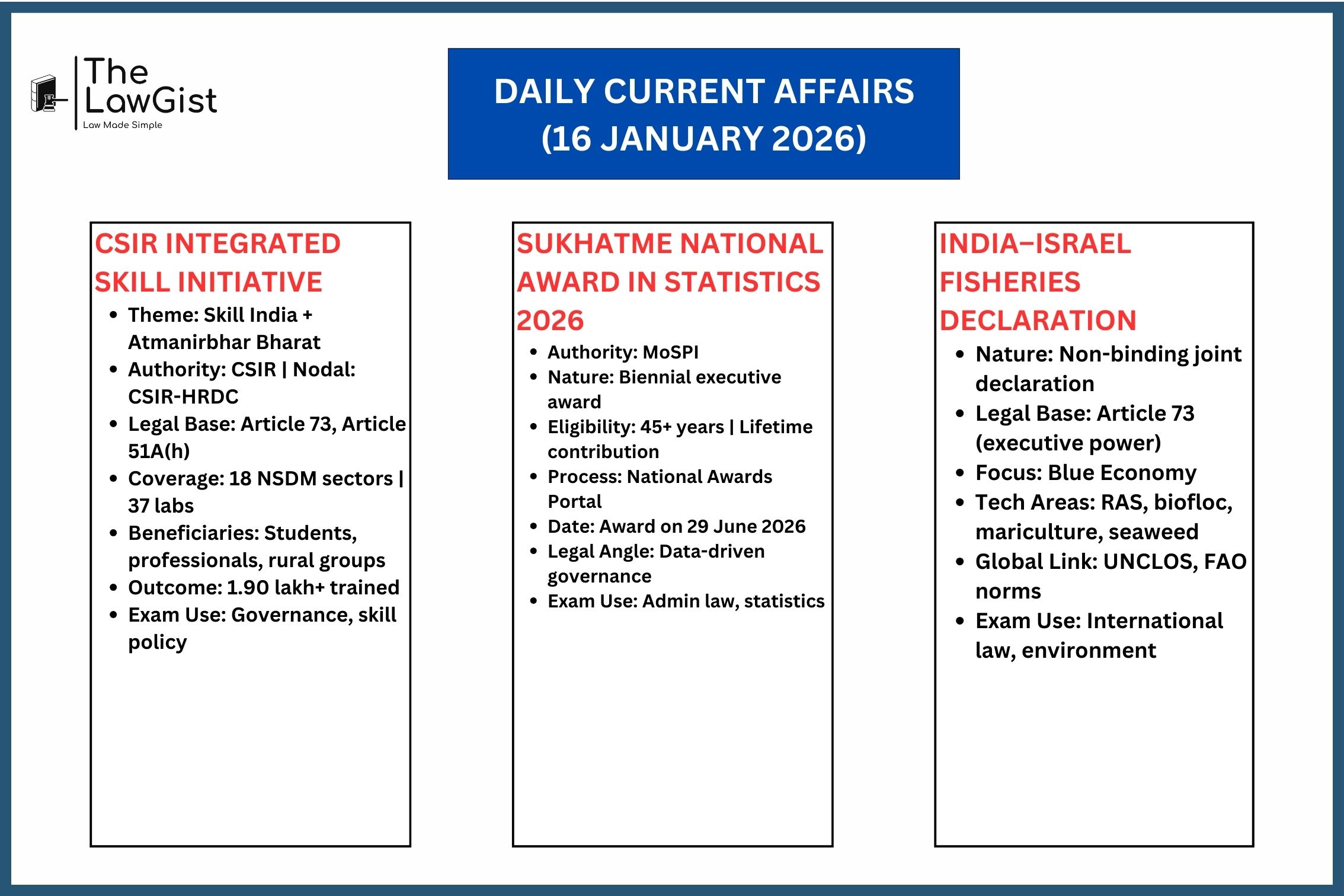
The CSIR Integrated Skill Initiative (CISI) is a flagship national programme implemented by the Council of Scientific and Industrial Research (CSIR) to bridge the gap between scientific research, industry requirements, and employable skills. Aligned with the national visions of Atmanirbhar Bharat and Skill India, the initiative leverages CSIR’s extensive research infrastructure and scientific expertise. It caters to a wide range of beneficiaries including students, researchers, professionals, farmers, and rural communities. The programme spans 18 key sectoral skills identified under the National Skill Development Mission. Having trained over 1.90 lakh individuals in Phases I & II, Phase III was launched in June 2025, training more than 14,000 trainees across 37 CSIR laboratories. CSIR-HRDC, Ghaziabad acts as the nodal monitoring authority.
Legal Perspective
The CSIR Integrated Skill Initiative operates within the framework of executive policy-making powers of the Union Government under Article 73 of the Constitution of India. It complements statutory schemes under the National Skill Development Mission (NSDM) and reflects the constitutional mandate of promoting scientific temper under Article 51A(h). While not backed by a standalone statute, the initiative exemplifies policy-driven governance, public institutional collaboration, and decentralized implementation through CSIR laboratories, reinforcing the role of executive action in socio-economic development.
- Constitutional Basis: Article 73 and Article 51A(h)
- Policy Framework: National Skill Development Mission
- Nature: Executive-driven skill development programme
- Principle: Inclusive growth and capacity building
- Impact: Enhances employability and industry-ready workforce
Why This News Is Important - For Exams: Executive power (Article 73) and scientific temper (Article 51A)
- For Aspirants: GS-II & GS-III: governance, skill development
- For Legal Practice:Executive policymaking and non-statutory schemes
- For Policy Understanding: Strengthens India’s skill ecosystem
SUKHATME NATIONAL AWARD IN STATISTICS 2026: RECOGNISING EXCELLENCE IN OFFICIAL STATISTICS
Summary of the News
The Ministry of Statistics and Programme Implementation (MoSPI) has invited online nominations for the Sukhatme National Award in Statistics – 2026 through the National Awards Portal. Instituted in the year 2000, the award is conferred biennially on eminent Indian statisticians aged 45 years and above for lifetime contributions and outstanding research in statistics, particularly in improving official statistical systems. Eligible candidates may self-nominate or be nominated by institutions. The last date for nominations is 31 January 2026, and the award will be presented on Statistics Day (29 June 2026). The award includes a citation, shawl, memento, and an address by the awardee on their work.
Legal Perspective
The Sukhatme National Award represents a form of executive recognition under administrative law, reinforcing the importance of evidence-based governance. Awards instituted by ministries fall under the executive domain and do not require legislative backing. The award promotes statistical integrity, transparency, and accountability—core components of good governance. Reliable official statistics are essential for policy formulation, judicial review, and legislative oversight, thereby indirectly strengthening constitutional democracy and rule of law.
- Authority: Ministry of Statistics and Programme Implementation
- Nature: Executive administrative recognition
- Legal Principle: Transparency and data-driven governance
- Eligibility Framework: Policy-based, non-statutory criteria
- Impact: Improves quality of official statistics
Why This News Is Important - For Exams: Administrative law and data governance
- For Aspirants: GS-II & GS-IV: evidence-based governance
- For Legal Practice: Role of statistics in rule of law
- For Policy Understanding:Improves quality of official data
INDIA–ISRAEL JOINT DECLARATION ON FISHERIES & AQUACULTURE: A BLUE ECONOMY LEGAL PERSPECTIVE
Summary of the News
India and Israel signed a Joint Ministerial Declaration of Intent on 14 January 2026 to enhance cooperation in fisheries and aquaculture during the Blue Food Security: Sea the Future 2026 Summit in Eilat, Israel. The Indian delegation was led by Union Minister Shri Rajiv Ranjan Singh. The declaration focuses on advanced aquaculture technologies including RAS, biofloc, cage culture, aquaponics, mariculture, seaweed farming, and genetic improvement of species. It also emphasizes water-efficient technologies, start-up collaboration, and innovation. The agreement aims to boost food security, livelihoods, and sustainable development while advancing the Blue Economy of both nations.
Legal Perspective
The Joint Declaration is a non-binding executive agreement, reflecting diplomatic intent rather than enforceable treaty obligations. Under Article 73 of the Constitution, the Union Executive is empowered to engage in international cooperation without parliamentary ratification unless legislative changes are required. Such declarations function as soft law instruments, guiding future collaboration while aligning with India’s commitments under UNCLOS, sustainable development principles, and national fisheries policies like PM Matsya Sampada Yojana.
- Nature: Non-binding Joint Ministerial Declaration
- Constitutional Basis: Article 73 (executive power in foreign affairs)
- International Context: UNCLOS, FAO fisheries norms
- Principle: Sustainable development & Blue Economy
- Impact: Facilitates technology transfer and innovation
Why This News Is Important - For Exams: Foreign affairs and soft law instruments
- For Aspirants: GS-II & GS-III: IR and Blue Economy
- For Legal Practice: Non-binding international agreements
- For Policy Understanding: Advances sustainable fisheries cooperation
SOURCE – PIB
READ ALSO – DAILY CURRENT AFFAIRS (15 JANUARY 2026)