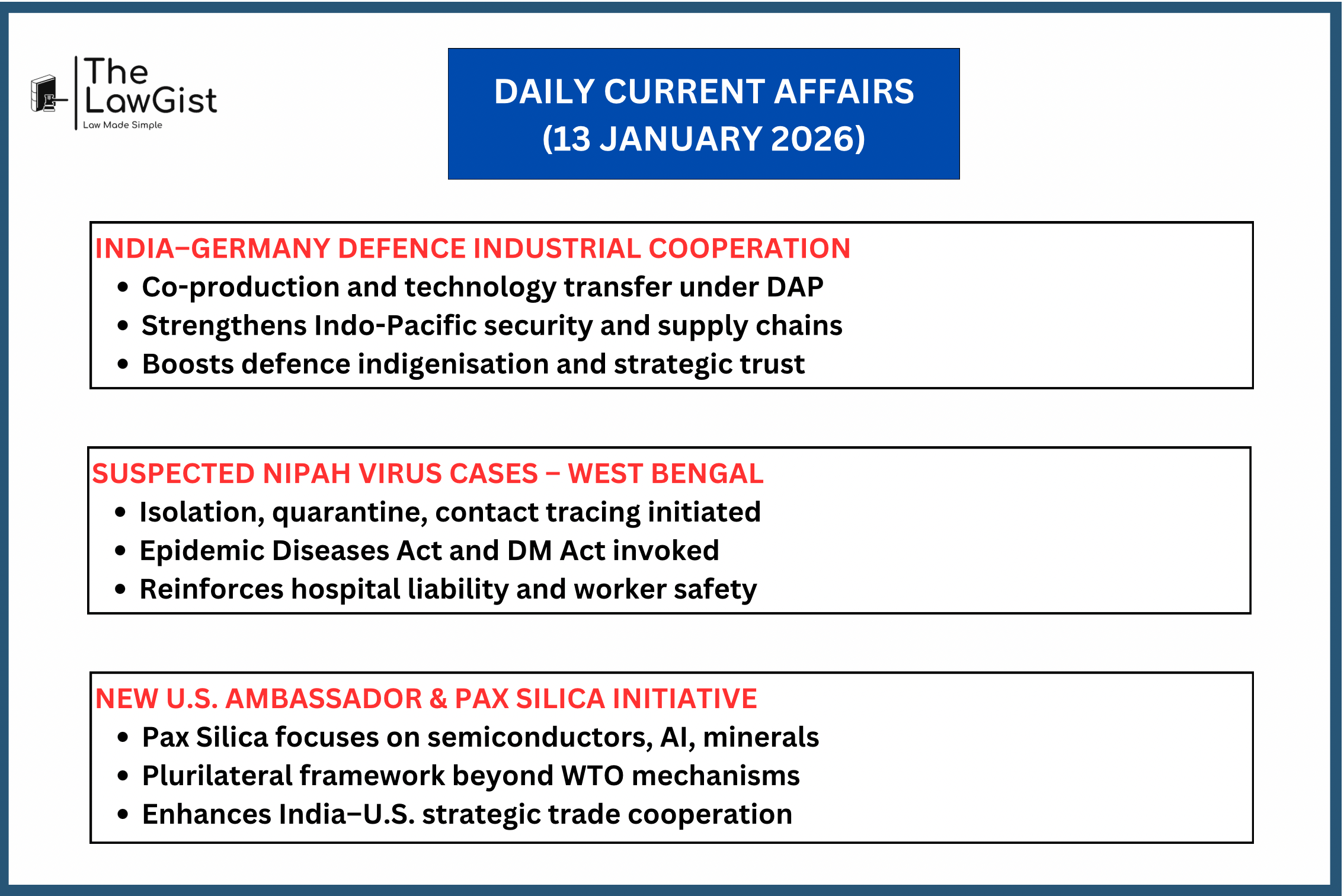
Major legal current affairs involving defence cooperation, public health governance, and strategic diplomacy in India
DAILY CURRENT AFFAIRS (13 JANUARY 2026)
INDIA–GERMANY DEFENCE INDUSTRIAL COOPERATION: LEGAL AND STRATEGIC DIMENSIONS
Summary of the News
India and Germany agreed to simplify defence trade and strengthen defence industrial cooperation during bilateral talks held on January 12, 2026. Prime Minister Narendra Modi and German Chancellor Friedrich Merz signed an agreement focusing on co-production and co-development in the defence sector. India also announced the launch of a consultation mechanism for cooperation in the Indo-Pacific region. Several MoUs were signed in areas such as skilled workforce mobility, higher education, sports, and healthcare recruitment. The leaders reiterated support for concluding the India–EU Free Trade Agreement and discussed global security issues, supply chain resilience, terrorism, and migration. Bilateral trade between the two countries has crossed $50 billion, reflecting a deepening strategic and economic partnership.
Legal Perspective
The agreement aligns with India’s Defence Acquisition Procedure (DAP) and defence FDI policy, promoting technology transfer, joint manufacturing, and ease of defence trade. It also reflects international trade law principles favouring free trade and resilient supply chains, while reinforcing India’s strategic autonomy and compliance with international security and migration norms.
- Laws/Policy Involved: Defence Acquisition Procedure (DAP), Defence FDI Policy
- Key Principle: Co-development and co-production in defence manufacturing
- International Aspect: Free trade, Indo-Pacific security cooperation
- Impact: Boosts defence indigenisation and bilateral strategic trust
Why This News Is Important
- For Exams: Relevant for international relations, defence policy, and trade law topics
- For Aspirants: Useful for UPSC GS II & III and state PSC current affairs
- For Legal Practice: Highlights defence procurement reforms and international agreements
- For Policy Understanding: Shows India’s shift towards defence self-reliance and strategic partnerships
SOURCE – PIB
SUSPECTED NIPAH VIRUS CASES IN WEST BENGAL: LEGAL AND PUBLIC HEALTH IMPLICATIONS
Summary of the News
Two nurses working at a private hospital in Barasat, North 24-Parganas, West Bengal, are suspected to be infected with the Nipah virus, a zoonotic disease with a high fatality rate. Both nurses are unconscious, on ventilator support, and isolated in the hospital’s ICU. Samples have been sent to AIIMS Kalyani, with final confirmation awaited from the National Institute of Virology (NIV), Pune. The State Health Department has initiated contact tracing, quarantined healthcare workers who treated the patients, and begun preparing a Standard Operating Procedure (SOP). Authorities have urged caution without panic. Experts highlight that healthcare workers are particularly vulnerable due to possible human-to-human transmission through prolonged contact.
Legal Perspective
The incident engages India’s public health emergency framework, including disease surveillance, quarantine powers, and hospital obligations. State authorities are empowered to enforce isolation, testing, and contact tracing under epidemic control laws. Hospitals have a legal duty to ensure infection control, occupational safety of healthcare workers, and compliance with biosecurity protocols. The situation also underscores coordination between state agencies and national health institutions under India’s infectious disease governance structure.
- Laws Involved: Epidemic Diseases Act, 1897; Disaster Management Act, 2005
- Key Principle: State’s duty to protect public health and healthcare workers
- Administrative Action: Isolation, quarantine, contact tracing, SOP formulation
- Impact: Reinforces infection control and hospital liability standards
Why This News Is Important
- For Exams: Relevant to public health law, disaster management, and emergency powers
- For Aspirants: Important for UPSC GS II (governance) and GS III (health security)
- For Legal Practice: Highlights hospital liability, workers’ safety, and state powers
- For Policy Understanding: Shows legal response mechanisms to emerging infectious diseases
SOURCE – WHO
NEW U.S. AMBASSADOR TO INDIA AND PAX SILICA INITIATIVE: LEGAL AND DIPLOMATIC SIGNIFICANCE
Summary of the News
Sergio Gor has assumed charge as the incoming U.S. Ambassador to India, ahead of formally presenting his credentials to President Droupadi Murmu. In an unprecedented public address, he announced that India will be invited to join the U.S.-led “Pax Silica” initiative, an eight-nation framework aimed at cooperation in semiconductors, critical minerals, and artificial intelligence. He also expressed optimism about reviving stalled India–U.S. trade negotiations, strained by tariff disputes and geopolitical differences. The announcement comes amid diplomatic sensitivities over protocol, trade tensions, Russian oil imports, and regional security issues. Mr. Gor also holds the role of U.S. Special Envoy for South and Central Asia, adding strategic weight to his appointment.
Legal Perspective
The development touches upon international trade law, diplomatic protocol, and strategic economic governance. Pax Silica reflects plurilateral cooperation beyond traditional WTO mechanisms, focusing on resilient supply chains and strategic technologies. The Ambassador’s early public statements raise questions of diplomatic convention under the Vienna Convention on Diplomatic Relations, 1961, though not amounting to a legal breach. Trade negotiations involve tariff regulation, bilateral trade agreements, and alignment with global supply chain security frameworks amid rising protectionism.
- Relevant Law: Vienna Convention on Diplomatic Relations, 1961
- Trade Aspect: Bilateral trade negotiations and tariff disputes
- Strategic Framework: Pax Silica – semiconductors, AI, critical minerals
- Impact: Strengthens techno-strategic cooperation beyond multilateral trade regimes
Why This News Is Important
- For Exams: Relevant to international relations, trade law, and diplomatic protocol
- For Aspirants: Useful for UPSC GS II (foreign policy) and GS III (technology & trade)
- For Legal Practice: Highlights emerging plurilateral frameworks and trade diplomacy
- For Policy Understanding: Shows shift towards strategic supply chain alliances in global governance
Read Also- DAILY CURRENT AFFIAR ( 12 JANUARY 2026)