Supreme Court holds High Courts cannot quash cheque dishonour cases by pre-trial enquiry under Section 482 CrPC.
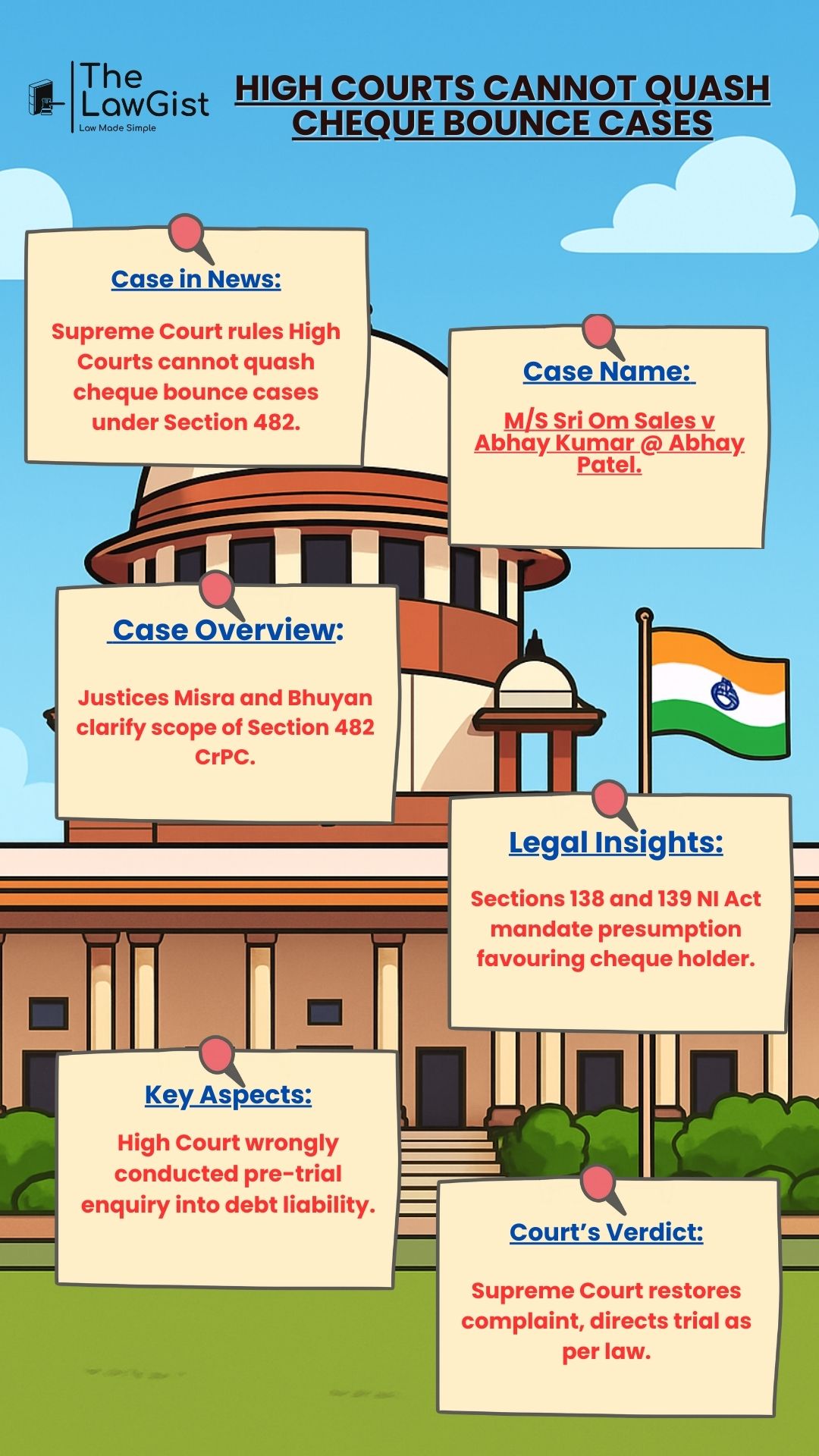
Case in NewsHigh Courts Cannot Quash Cheque Bounce Cases reiterates limits of inherent powers under Section 482 . |
Discover powerful Latin Maxims and simplify complex legal terms in seconds.
Case Overview
Case Name: M/S Sri Om Sales v. Abhay Kumar @ Abhay Patel & Anr.
The Supreme Court clarified the scope of inherent powers under Section 482 CrPC in cheque dishonour cases . A Bench of Justice Manoj Misra and Justice Ujjal Bhuyan set aside the Patna High Court’s order which had quashed a complaint under Section 138 NI Act at the pre-trial stage . The High Court had conducted a detailed enquiry into whether a legally enforceable debt existed . The Supreme Court held such an approach impermissible when statutory presumptions operate in favour of the complainant .
Step into the world of justice with Courtroom Chronicles
Key Aspects
The case examines the recurring issue of High Courts exceeding their jurisdiction by assessing disputed facts before trial . The Court emphasized that criminal complaints disclosing prima facie offences must proceed to trial .
- Cheque dishonour complaint was quashed by the High Court using Section 482 powers .
- High Court examined disputed facts relating to debt and liability pre-trial .
- Complaint disclosed prima facie ingredients of Section 138 NI Act .
- Statutory presumption under Section 139 NI Act was ignored by the High Court .
Legal Insights
The judgment reinforces settled principles governing quashing of criminal proceedings . It underscores legislative intent behind presumptions in negotiable instruments law and procedural discipline under criminal jurisprudence .
- Section 138 NI Act: Criminal liability arises upon dishonour of cheque for legally enforceable debt .
- Section 139 NI Act: Presumption in favour of holder that cheque was issued towards debt or liability .
- Section 482 CrPC: Inherent powers cannot be exercised for roving or factual enquiry .
- Appreciation of evidence is permissible only during trial, not at the threshold stage .
Court’s Verdict
Allowing the appeal, the Supreme Court restored the criminal complaint to the Magistrate’s file . It held that the High Court erred in quashing proceedings by conducting a pre-trial enquiry, directing the matter to proceed in accordance with law .
Source – Supreme Court of India
Read also – CrPC
The LawGist ensures exam success with quality notes—TPL, Current Affairs, Recent Judgments, and more. Backed by trusted resources and videos, The LawGist is every aspirant’s first choice.