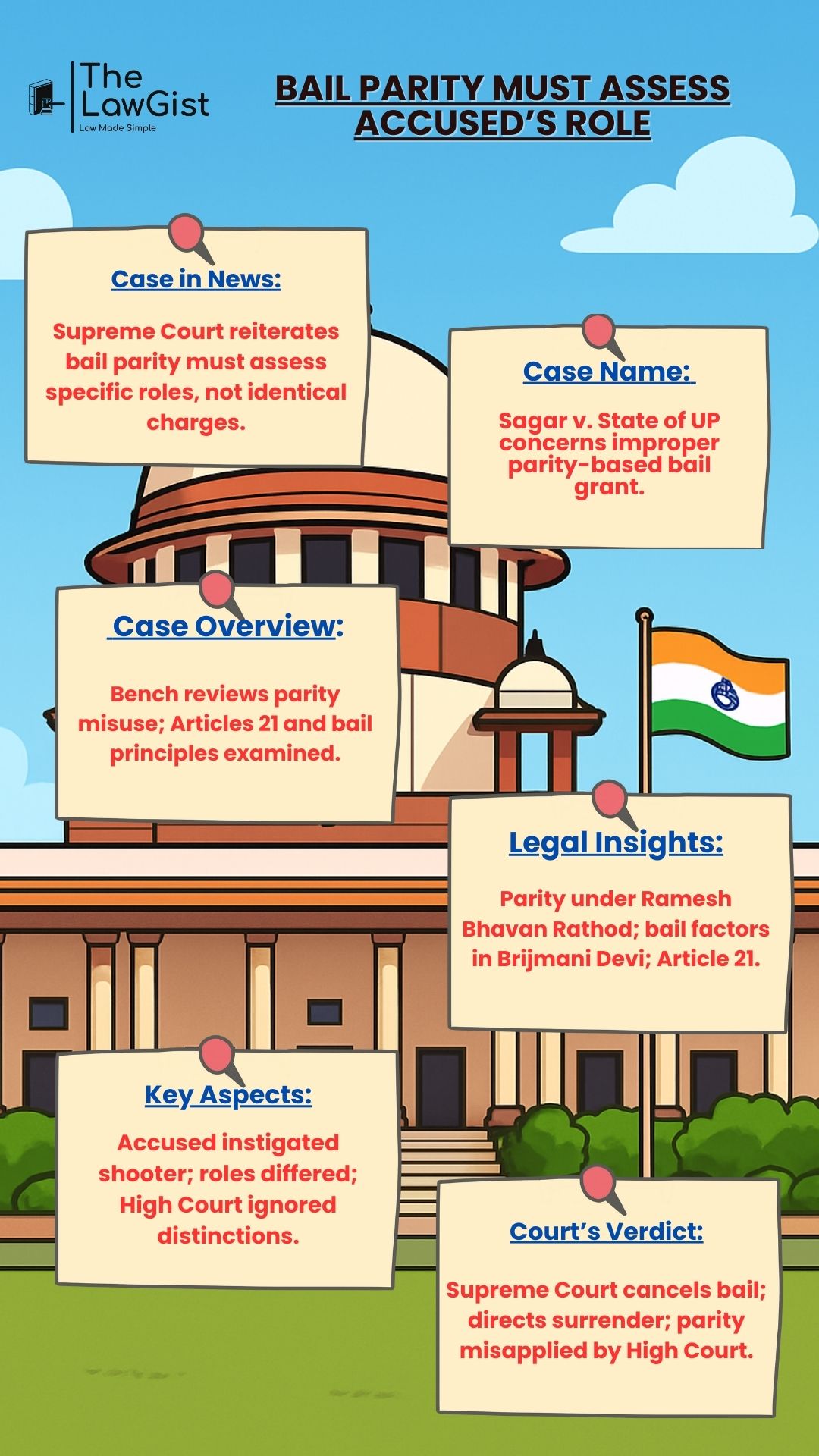
Supreme Court overturns bail granted solely on parity, stressing that courts must examine each accused’s specific role and circumstances before granting bail.
Case in NewsSupreme Court rules Bail Parity Must Assess Accused’s Role while overturning High Court bail order . |
Discover powerful Latin Maxims and simplify complex legal terms in seconds.
Case Overview
Case Name: Sagar vs. State of Uttar Pradesh & Anr.
The Supreme Court comprising Justice Sanjay Karol and Justice N Kotiswar Singh, set aside an Allahabad High Court order granting bail solely on the ground of bail on parity . The High Court had extended bail to accused Rajveer and Prince by relying on bail earlier granted to co-accused Suresh Pal, without analysing their individual roles . The bench emphasized that bail cannot be granted solely on parity unless the roles and circumstances of the accused are identical . The appeal was filed by the complainant challenging the High Court’s reasoning .
Step into the world of justice with Courtroom Chronicles
Key Aspects
Before examining legal doctrine, the factual matrix reveals crucial distinctions among the accused, highlighting why the grant of bail was problematic .
- A family dispute escalated when accused persons allegedly blocked and assaulted the complainant’s family .
- Respondent Rajveer allegedly instigated co-accused Aditya to shoot the deceased .
- Bail of shooter Aditya was rejected, while Suresh Pal’s bail was earlier overturned by the Supreme Court .
- High Court granted bail to Rajveer and Prince solely because Suresh Pal had earlier received bail .
- Individual roles, intention and participation were never independently assessed .
Legal Insights
A brief look at governing principles shows that courts must evaluate specific conduct before granting bail .
- Parity Principle – Ramesh Bhavan Rathod (2021) 6 SCC 230 – Parity applies only when roles and circumstances are identical .
- Bail Parameters – Brijmani Devi (2022) 4 SCC 497 – Courts must assess nature of allegations, severity of punishment, witness influence, evidence tampering, antecedents and prima facie satisfaction .
- Article 21 of Constitution of India– Personal Liberty – Bail discretion must align with fairness and judicial reasoning .
Court’s Verdict
The Supreme Court held that the High Court wrongly applied parity without examining the specific role of each accused . It ruled that an instigator like Rajveer could not be compared with others having lesser roles . Bail was set aside and the accused was directed to surrender .
Source – Supreme Court of India
Read also – Constitution of India
The LawGist ensures exam success with quality notes—TPL, Current Affairs, Recent Judgments, and more. Backed by trusted resources and videos, The LawGist is every aspirant’s first choice.