Supreme Court clarifies Arbitral Tribunal’s jurisdiction to implead parties despite lack of notice under Section 21 of the Arbitration Act.
Case in News
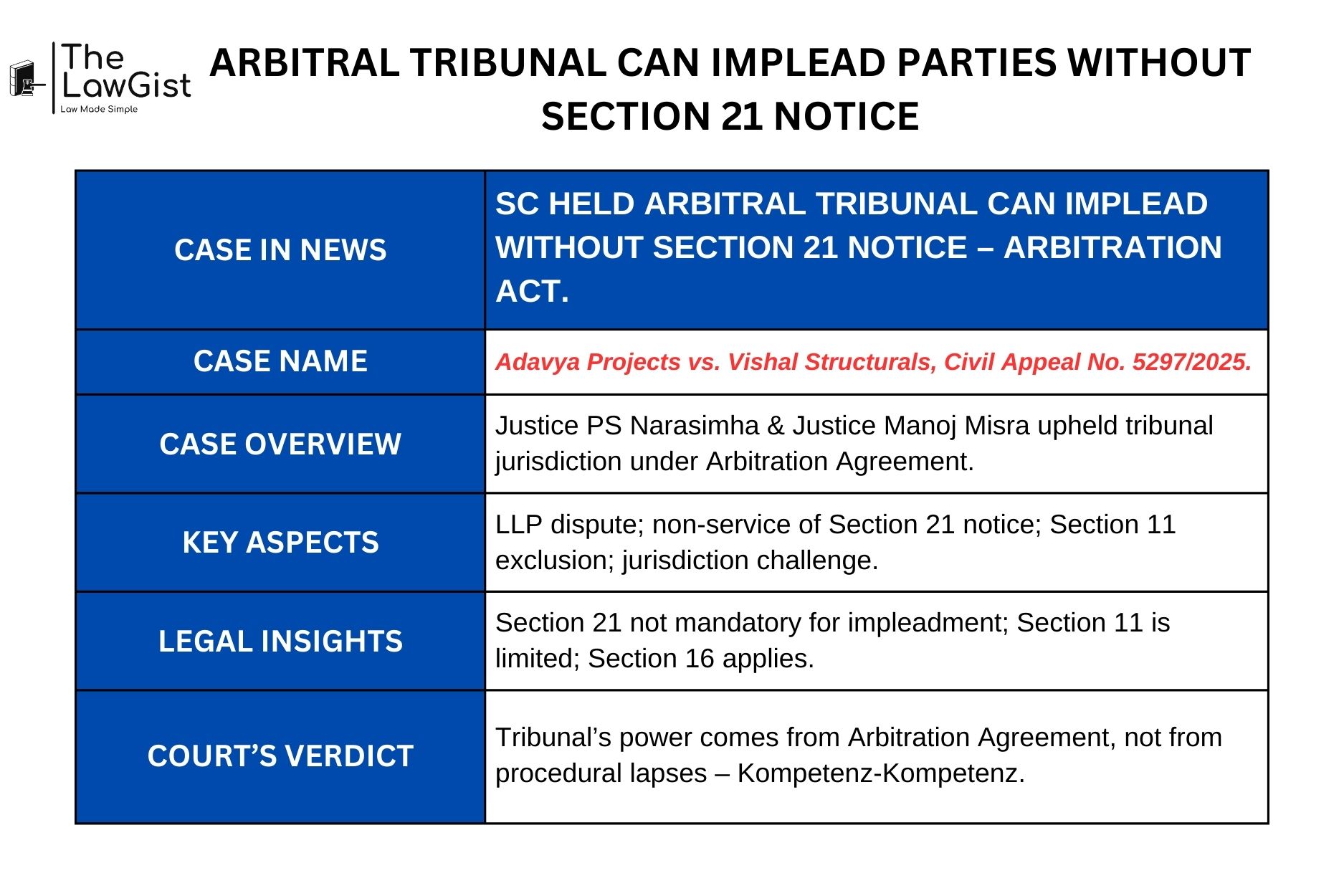
The Arbitral Tribunal Can Implead Parties Without Section 21 Notice stated by Supreme Court in Arbitration.
Case Overview
Case Name – Adavya Projects Pvt. Ltd. vs. M/s Vishal Structurals Pvt. Ltd. & Ors.,
In a judgment the Supreme Court of India bench comprising Justice PS Narasimha and Justice Manoj Misra held that the Arbitral Tribunal can proceed against parties even if they weren’t issued a Section 21 of the Arbitration Act notice or weren’t made party in the Section 11 Of Arbitration Act application . The case arose from disputes in an LLP venture relating to non-signatory parties acting under the clause of arbitration .
Key Aspects
- Dispute happened in an LLP project between Adavya Projects and Vishal Structurals.
- Arbitration was invoked with a notice of arbitration only to Respondent No.1.
- Appointment of arbitrator was made under Section 11 Of Arbitration Act, excluding Respondents 2 & 3 .
- Later they were impleaded; they challenged it stating Non-Service of notice and non-inclusion in Section 11 application .
- The Arbitral Tribunal and High Court rejected their impleadment .
Legal Insights
- Section 21 of the Arbitration Act : Notice is mandatory but not serving as it does not bar impleadment.
- Section 11 of Arbitration Act : Has Limited scope and doesn’t bind jurisdiction of the tribunal.
- Section 16 of Arbitration Act: Kompetenz-Kompetenz principle permits the tribunal to decide its own jurisdiction .
- Being a party to the Arbitration Agreement is important and not procedural steps.
- Referenced the case of Cox & Kings vs. SAP India and State of Goa vs. Praveen Enterprises.
Court’s Verdict
The Supreme Court of India stated that jurisdiction Of The Arbitral Tribunal stems from consent to the Arbitration Agreement and not procedural formalities. It set aside the view of the High Court and permitted Impleadment of Parties who acted under the LLP Agreement terms, affirming the tribunal’s authority to proceed .
Source